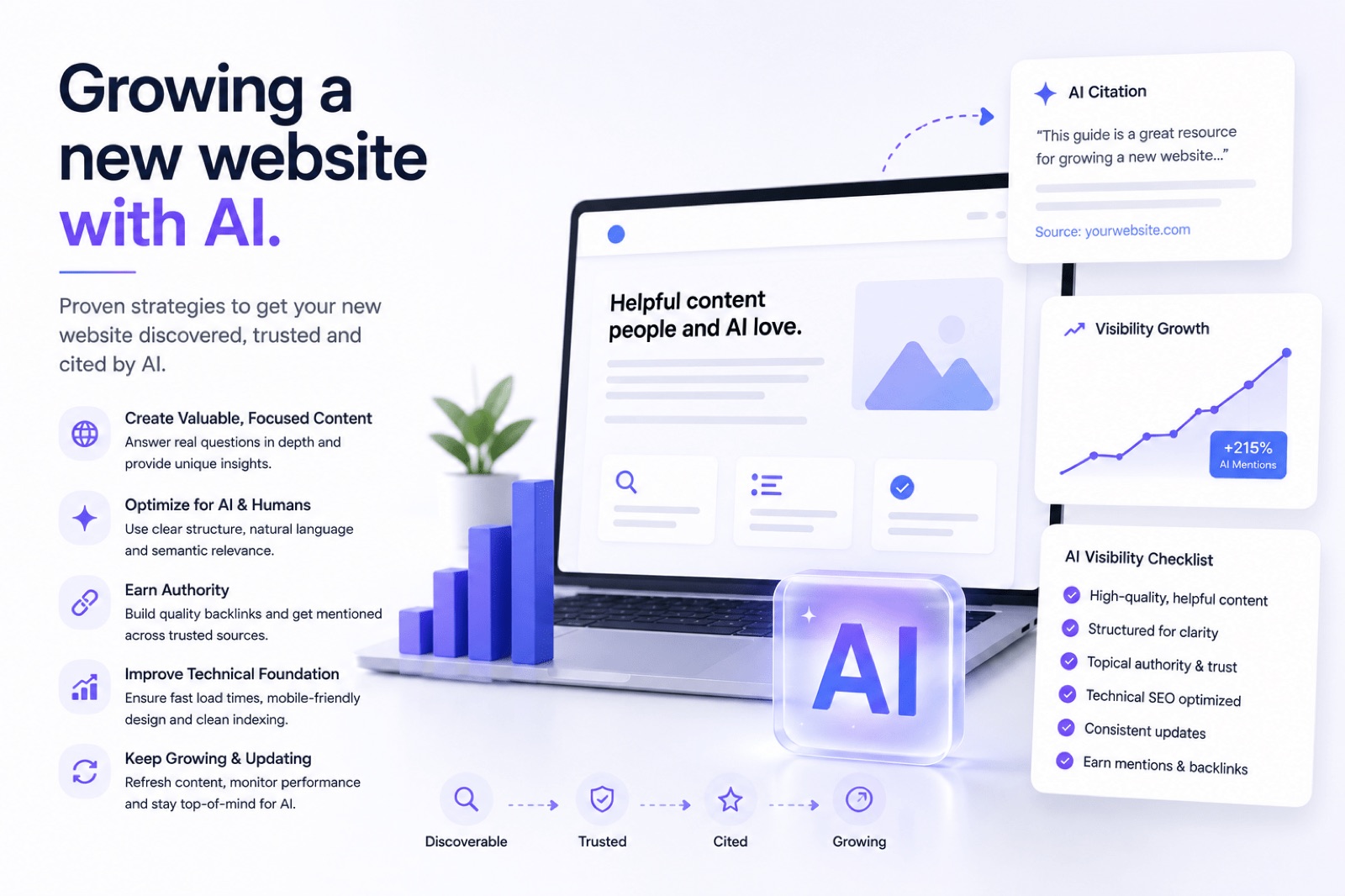
Knowing how to grow new website with AI gives you a real advantage when you are starting from zero. Most new websites struggle to gain traction because they publish random content without a clear strategy. However, AI-driven search is changing the rules. AI Overviews, Perplexity, and ChatGPT now cite websites directly in their answers. Therefore, getting your content structured for AI citation from day one is one of the smartest moves you can make. This guide covers exactly what to do first.
Why Growing a New Website with AI Starts with the Right Content Strategy
Growing a new website with AI requires a clear content foundation before anything else. A new site has no domain authority, no backlinks, and no search history. That might sound like a disadvantage. In fact, it is also a clean slate — and AI search engines reward structured, useful content regardless of domain age.
Traditional SEO took months or even years to pay off for new sites. However, AI Overviews and AI answer engines pull from content that directly answers specific questions. Therefore, if you publish well-structured, answer-focused articles from the start, you have a genuine shot at being cited early.
Before you write a single article, decide on three things:
- Your core topic cluster: Pick one focused subject area and own it deeply.
- Your target audience: Be specific about who you are writing for and what they need.
- Your content format: Prioritise articles that answer direct questions clearly and completely.
Additionally, connect your site to Google Search Console from day one. Search data from even a small number of impressions will show you which queries your site is appearing for. Furthermore, that data becomes your most valuable planning tool as your site grows.
Publish AEO-Optimised Content Frequently to Keep Growing New Website with AI
AEO-optimised content — Answer Engine Optimisation — is the practice of structuring articles so AI systems can extract and cite them directly. For a brand new website, publishing this type of content frequently is the single most important activity you can do.
AI engines like Google’s AI Overviews, Perplexity, and ChatGPT look for content that is self-contained, clearly structured, and answers questions in full. Therefore, every article you publish should be built with this in mind from the start. For a deeper look at how to structure each article correctly, read this guide on writing an AEO optimised article.
What Frequent Publishing Actually Means
Frequency matters, but quality matters more. Publishing two well-structured, in-depth articles per week is far more effective than publishing five thin pieces. Each article should cover a specific question in full, use headers to organise information, and avoid vague or generic statements.
Key practices for every article you publish:
- Open each section with a direct definition — AI engines extract individual paragraphs, so each one must make sense alone.
- Use FAQ sections — These match how people ask questions in AI search.
- Bold key answers — This helps AI engines identify the core takeaway instantly.
- Keep sentences short and active — Complex sentence structures reduce extractability.
- Cover one topic thoroughly — Partial answers rarely get cited by AI Overviews.
Realistic Expectations for New Websites
Here is an honest expectation: AI citations do not happen overnight. Most new websites take three to six months of consistent, structured publishing before they start appearing in AI Overviews. However, that timeline shortens significantly when every article is built for AEO from day one. Furthermore, niche topics with less competition can see AI citations in as little as six to eight weeks. The key is consistency, structure, and genuine usefulness.
How Comparison Pages Help You Grow New Website with AI Faster
Comparison pages are one of the most underused tools for growing a new website with AI. These pages directly match high-intent search queries like “X vs Y” or “best alternatives to X.” AI engines frequently cite comparison content because it answers a very specific, useful question in a structured way.
For a new website with no authority, comparison pages offer an important shortcut. Searches comparing tools, products, or services often have lower competition than broad topic queries. Additionally, these pages are naturally structured with tables, bullet points, and clear conclusions — which is exactly what AI engines prefer to extract.
Effective comparison pages should include:
- A clear comparison table showing features, pricing, or key differences side by side.
- A summary verdict at the top answering the question directly — do not bury the answer.
- Individual sections for each option with standalone descriptions that make sense out of context.
- A FAQ section addressing common questions about each option.
For example, pages like AI visibility tools compared perform well in AI search because they directly answer “which tool should I use?” with structured, factual information. Publishing your own comparison pages in your niche gives your new site a real route into AI-cited results early on.
Additional Best Practices to Get Cited by AI Overviews Sooner
Getting cited by AI Overviews faster on a new website requires more than good writing. Several structural and technical practices make a measurable difference, especially when your domain is new and has no existing authority.
First, build strong internal linking from the start. Every new article should link to two or three related articles on your site. This helps AI engines understand your site’s topic structure and signals that your content is part of a coherent knowledge base. To understand the full picture of what drives AI citation, read this guide on what is AI search visibility.
Technical and Structural Practices Worth Prioritising
Beyond content quality, these practical steps support faster AI visibility:
- Use schema markup — FAQ schema and Article schema help AI engines identify and extract your content correctly.
- Write clear page titles and meta descriptions — These act as signals for what your content covers.
- Keep URLs clean and descriptive — Short, topic-clear URLs help AI systems categorise your pages.
- Publish original perspectives — AI engines prefer content that adds something new, not just restates what already exists.
- Update content regularly — Fresh, maintained content signals reliability to both Google and AI engines.
Furthermore, focus on building topical authority rather than trying to cover every subject. A new website that thoroughly covers one area will be cited more quickly than a site that publishes superficially across many topics. Consistency within a focused niche is the fastest route to AI visibility on a new domain.
Comparison of Content Types for AI Citation on a New Website
Not all content performs equally when your goal is to grow new website with AI citations. Understanding which content types are most effective helps you plan your publishing schedule with purpose.
| Content Type | AI Citation Potential | Best For | Time to Impact |
|---|---|---|---|
| AEO-optimised how-to articles | High | Answering specific questions directly | 6–12 weeks |
| Comparison pages (X vs Y) | High | Decision-stage queries with clear intent | 4–10 weeks |
| FAQ-focused pages | High | Matching conversational AI search queries | 4–8 weeks |
| Generic blog posts | Low | Brand awareness only | Unpredictable |
| Listicles without structure | Low–Medium | Broad awareness, limited AI extraction | Slow |
| Data-led research articles | Medium–High | Building authority and backlinks over time | 12–20 weeks |
Therefore, prioritise AEO articles, comparison pages, and FAQ content in your first three months. These formats are the most likely to be cited by AI Overviews and answer engines when your domain is still new and building authority.
How Remway Helps You Grow New Website with AI from Day One
Remway is built specifically for the challenge of growing a new website with AI-driven search in mind. Most new website owners know SEO matters, but they are unsure what to write, which topics to target, or how to structure content for AI citation. Remway solves all three problems using real search data.
Instead of guessing what to write next, Remway connects to your Google Search Console data and finds real content opportunities from your actual impressions, clicks, and average position data. Even a new site with a small amount of search data can find low-hanging SEO opportunities and plan better articles quickly. Furthermore, Remway helps you create SEO-ready articles that match your brand voice and are structured for AI citation from the start.
Remway is particularly useful for:
- Finding what to write next — Based on real search queries your site is already appearing for.
- Turning search data into articles — Remway helps you move from raw data to a publishable, structured article faster.
- Building a consistent content strategy — Plan your comparison pages, FAQ articles, and AEO content in one place.
- Tracking content opportunities over time — As your site grows, Remway surfaces new opportunities automatically.
For founders, small teams, and website owners who want to grow with real search insights rather than guesswork, Remway provides a smarter, faster content planning workflow. Additionally, it supports the kind of data-led SEO that gives new websites the best chance of being cited by AI Overviews early.
Frequently Asked Questions
How long does it take for a new website to get cited by AI Overviews?
Most new websites take three to six months of consistent publishing before they appear in AI Overviews. However, niche topics with lower competition can see citations in six to eight weeks. The key factor is publishing AEO-optimised content frequently, with clear structure, direct answers, and FAQ sections. Domains with strong topical focus tend to get cited faster than broad, general websites publishing inconsistently.
What is AEO and why does it matter for a new website?
AEO stands for Answer Engine Optimisation. It is the practice of structuring content so AI search engines can easily extract and cite it. For a new website, AEO matters because it gives your content a route into AI Overviews and tools like Perplexity even before you have built significant domain authority. Well-structured, self-contained answers are cited based on quality, not just domain age.
Why are comparison pages so effective for new websites?
Comparison pages target high-intent search queries like “X vs Y” or “best alternatives to X.” These searches are specific, common, and frequently answered by AI Overviews. Comparison pages also naturally use tables, clear verdicts, and structured sections — which are exactly the formats AI engines prefer to extract. For a new website, comparison pages can generate AI visibility faster than broad topic articles.
Do I need a lot of content before my new website gets noticed by AI search?
Quality matters more than volume. Starting with ten to fifteen well-structured, AEO-optimised articles in a focused topic area is more effective than publishing fifty thin pieces across random subjects. AI engines reward depth, clarity, and topical coherence. Therefore, focus on covering your core subject thoroughly before expanding into new areas. Consistent publishing over time builds the topical authority that AI systems recognise.
How does Remway help with growing a brand new website?
Remway helps you grow new website with AI by connecting to your Google Search Console data and identifying real content opportunities from actual search queries. Even new sites with limited data can find useful insights quickly. Remway then helps you plan and create SEO-ready articles structured for AI citation, comparison pages, and FAQ content. It removes guesswork from content planning and supports a consistent, data-led SEO workflow from day one.