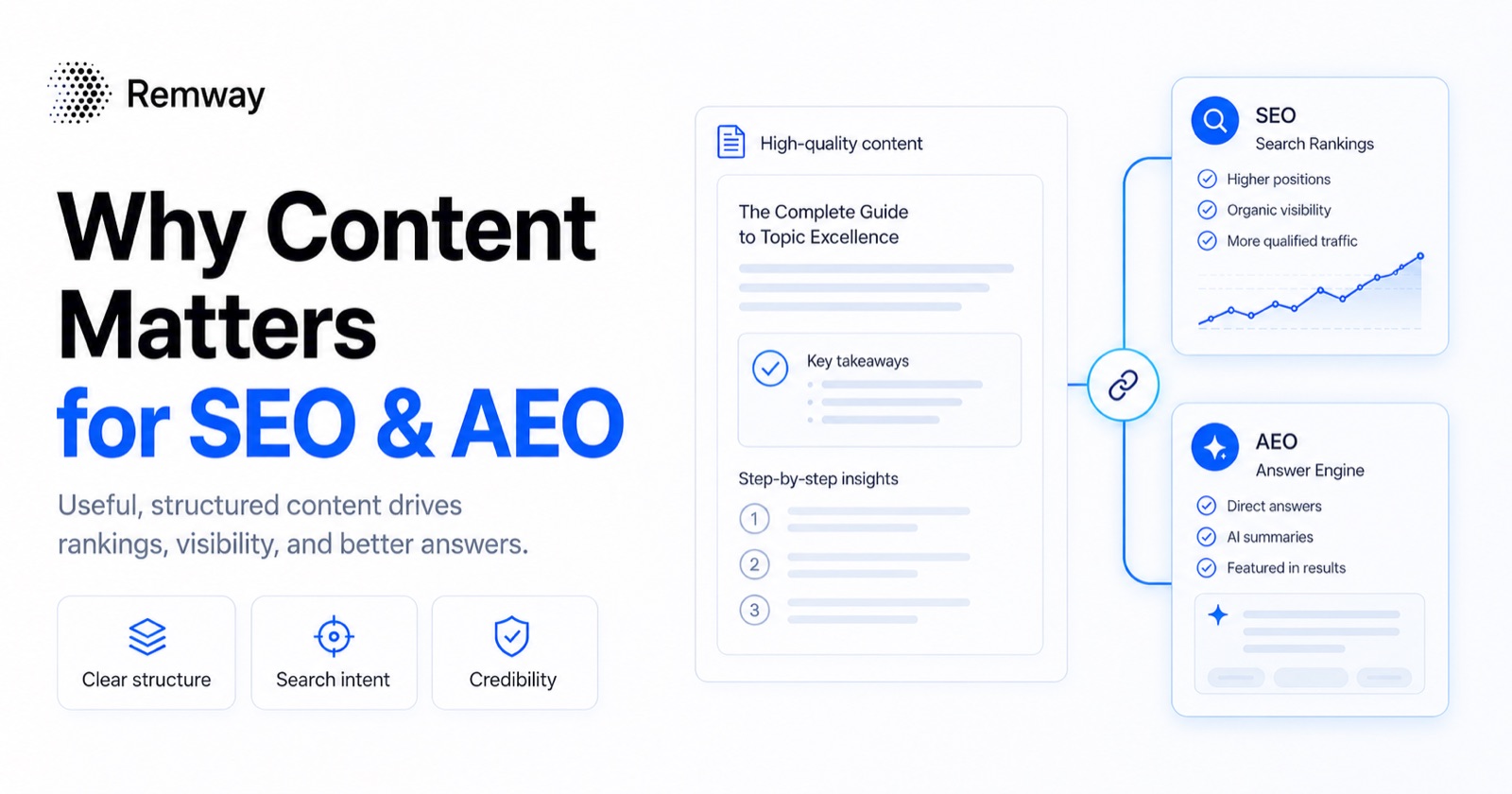
SEO and AEO content is the foundation of any website that wants to be found, understood, and referenced by both search engines and AI-powered answer systems. A website cannot rank for a useful topic or appear as a source in an answer without publishing information that clearly covers that subject. Technical SEO helps search systems access and understand a website, but content gives those systems something valuable to index, rank, summarise, and reference. The same high-quality content can support both SEO and AEO when it combines depth with clear, extractable answers.
What Is SEO Content?
SEO content is website content created to answer relevant searches while helping search engines understand the subject, purpose, and value of the page. Good SEO content is not simply text containing keywords. It serves a specific search intent, covers a defined topic thoroughly, and provides something more useful than a generic summary.
Effective SEO content typically:
- Matches a clear search intent
- Uses descriptive headings that reflect what each section explains
- Answers relevant questions the audience is actively asking
- Connects logically to other pages on the same website
- Demonstrates experience or genuine expertise on the subject
- Encourages qualified users to visit, read, and engage
According to Google’s people-first content guidance, content should be created for people first, with search engine optimisation applied on top — not the other way around.
What Is AEO Content?
AEO content, or Answer Engine Optimisation content, is information structured so that answer engines can easily identify, understand, and extract a useful response to a specific question. Answer engines include AI-powered systems that summarise or cite sources when responding to a search query.
AEO-friendly content often includes:
- Direct answers placed near the beginning of the page
- Clear question-based headings
- Concise definitions followed by supporting explanation
- Tables, comparisons, and structured lists
- Visible FAQs that address common follow-up questions
- Credible sources and transparent authorship
Importantly, AEO does not require writing a completely separate version of every page. Strong SEO content, when well-structured, already does much of this work. Additionally, Google provides specific AI search optimisation guidance that reinforces the value of clear, helpful, well-organised content.
SEO and AEO Content: What Is the Difference?
SEO and AEO content share the same quality standards, but they emphasise slightly different outcomes. SEO focuses on helping content become discoverable through traditional search. AEO focuses on making the information within that content easier for answer systems to understand and use.
| Factor | SEO Content | AEO Content |
|---|---|---|
| Primary goal | Rank for relevant searches | Appear as a reliable source in AI answers |
| Audience | Search engine crawlers and human readers | Answer engines and human readers |
| Key emphasis | Search intent, relevance, authority | Direct answers, structure, extractability |
| Content format | Well-written articles, guides, landing pages | Structured sections, FAQs, definitions, tables |
| Success signal | Clicks, rankings, impressions | Citations, featured answers, entity recognition |
| Overlap | Both require useful, accurate, well-organised content | |
Therefore, SEO helps content become discoverable, while AEO helps the information within that content become easier to understand and use. The two goals reinforce each other rather than conflict.
Why Content Is Essential for SEO
Content is the primary signal search engines use to understand what a page covers, which queries it should appear for, and how useful it is to real people. Without useful content, even a technically well-optimised website has little to offer the people searching for information.
Content Establishes Relevance
Search engines need enough information to understand what a page is about. A page covering a topic in clear detail gives search systems the signals needed to connect it with the right searches. However, relevance is not only about mentioning a topic — it is about covering it in a way that genuinely helps the reader.
Content Matches Search Intent
A page is more useful when its format and information match what the searcher actually wants. For example, a definition query needs a clear explanation. A comparison query needs balanced differences. A how-to query needs ordered instructions. A commercial query may need features, evidence, and decision support. Matching format to intent is one of the most practical ways to improve organic visibility.
Content Builds Topical Authority
Publishing several useful pages around a connected subject helps create a clearer picture of what the website covers. A business that consistently publishes relevant, accurate content on a defined set of topics builds a coherent body of information. This is not a guaranteed ranking mechanism, but it does help search engines associate the site with specific subjects over time.
Content Creates Internal Linking Opportunities
Strong content gives websites meaningful pages to connect together. Internal links can help users discover related information, help crawlers locate pages, show relationships between topics, and direct readers towards product or conversion pages. Furthermore, a well-linked content library is easier to navigate for both people and search systems.
Content Can Attract Links and Mentions
Useful research, original frameworks, practical templates, and clear explanations are more likely to be referenced by other websites. In contrast, generic articles covering the same ground as thousands of existing pages offer little reason for other publishers to link or refer to them.
Why SEO and AEO Content Both Depend on Quality
Answer systems need understandable, reliable source material. SEO and AEO content both require the same core ingredient: genuinely useful information, clearly presented. The structural elements that support AEO — concise answers, descriptive headings, specific examples — also improve the readability and usefulness of content for traditional search.
Direct Answers Make Information Easier to Extract
Answering the main question clearly before expanding into detail makes content more useful for both readers and answer engines. A reader who finds the answer immediately is more likely to trust the page. An answer system can more easily identify and use the information when it appears early and clearly.
Structure Provides Context
Descriptive headings, short sections, tables, and lists give both readers and systems a clear picture of what the page covers and how the information is organised. Poorly structured content is harder to navigate, harder to understand, and harder to extract useful information from.
Specificity Reduces Ambiguity
Generic statements are difficult to trust or reuse. Specific definitions, practical examples, stated conditions, and acknowledged limitations create clearer, more credible source material. Specificity also signals genuine knowledge of the subject, rather than a surface-level summary.
Credibility Supports Trust
Accurate claims, credible external sources, expert review, and transparent authorship all strengthen a page. Google’s guidance on using generative AI content makes clear that content quality and trust remain central, regardless of how content is produced.
What High-Quality SEO and AEO Content Looks Like
High-quality SEO and AEO content shares a consistent set of characteristics. The table below summarises what to aim for.
| Content Element | What Good Looks Like | What to Avoid |
|---|---|---|
| Opening | Clear answer or definition near the top | Long preamble before any useful information |
| Headings | Descriptive, question-based, topic-specific | Vague headings like “Introduction” or “More Information” |
| Depth | Covers the topic with relevant detail and examples | Generic summaries that repeat widely available information |
| Structure | Short paragraphs, lists, tables where useful | Dense blocks of text with no visual organisation |
| Evidence | Specific examples, data, observations, sources | Unsupported claims or vague generalisations |
| Intent match | Format matches what the searcher actually needs | Article format used for queries that need a tool or checklist |
| FAQs | Real questions answered with useful, self-contained responses | FAQs added only to tick an SEO box |
Why Publishing More Content Is Not Always Better
Volume alone does not create search visibility or topical authority. Publishing large numbers of thin, repetitive, or unrelated articles can actually dilute the quality signals associated with a website. Furthermore, multiple pages targeting almost identical queries can compete against each other rather than reinforce each other.
Content that hurts rather than helps includes:
- Thin articles that repeat existing information without adding value
- AI-generated drafts published without human review or fact-checking
- Articles unrelated to the company’s genuine area of expertise
- Pages created only to increase post count
- Content containing keywords but failing to satisfy the underlying intent
A focused library of useful, connected articles is normally more valuable than a large archive of disconnected or repetitive posts. Quality and relevance matter more than quantity.
How to Create Content That Works for SEO and AEO
Creating effective SEO and AEO content follows a practical, repeatable workflow. Each step builds towards a page that is useful for readers and clear for search systems.
Step 1: Start With a Real Audience Question
Choose a specific question, problem, or decision the audience genuinely has. Real questions produce more useful content than abstract topic titles.
Step 2: Confirm the Search Intent
Identify whether the reader wants an explanation, instructions, a comparison, a recommendation, a tool, or troubleshooting support. The format of the content should match the answer the reader is actually looking for.
Step 3: Answer the Main Question Early
Include a concise answer near the beginning, followed by deeper supporting information. This serves readers who want a quick answer and those who want full detail.
Step 4: Build a Clear Heading Structure
Each heading should describe exactly what the section explains. Vague headings make content harder to navigate for readers and harder to parse for search systems.
Step 5: Add Evidence, Examples, and Experience
Add value beyond information found everywhere else. This might include first-hand observations, original frameworks, practical scenarios, relevant limitations, or data from your own workflow. Specificity is what separates genuinely useful content from generic summaries.
Step 6: Use Structured Elements Where Helpful
Include tables, checklists, numbered steps, definitions, FAQs, and summary boxes where they make the article easier to use. However, do not add these elements purely for SEO. They should improve the experience for the reader. Google’s Article structured data guidance also explains how markup can help search systems better understand page content.
Step 7: Connect the Article to Relevant Pages
Only link to pages that are live and genuinely related. Internal links help users discover related information and help search systems understand how pages relate to each other.
Step 8: Review and Improve the Article
Check accuracy, clarity, duplication, search intent match, formatting, and brand alignment before publishing. Additionally, review the article periodically to keep the information current and accurate.
How Search Data Helps You Decide What to Write
Content quality begins with choosing the right subject. Google Search Console provides search data that shows which queries are already driving impressions to a website, which pages have low CTR despite decent visibility, and which keywords sit in positions 11–20 with room to improve.
Useful signals from Google Search Console include:
- Queries receiving impressions but few or no clicks
- Pages with a low average CTR relative to their average position
- Keywords ranking between positions 11 and 20
- Unexpected relevant searches the website is already appearing for
- Groups of related queries that suggest a content gap
- Pages ranking for a topic they only partially cover
Using real search data to choose content topics means article ideas are grounded in actual audience behaviour rather than assumptions. This approach supports smarter content planning and reduces wasted effort on topics with little real search demand.
Generic Content vs Useful SEO and AEO Content: A Comparison
SEO and AEO content performs significantly better when it is specific, structured, and genuinely useful. The table below illustrates the difference clearly.
| Content Type | Generic Version | Useful SEO and AEO Version |
|---|---|---|
| Topic | “What is SEO?” | “Why content matters for SEO and AEO” |
| Opening | Long background before any answer | Direct definition or answer in the first paragraph |
| Depth | High-level overview with no examples | Practical explanations with real scenarios |
| Structure | Long paragraphs, no subheadings | Short sections, descriptive headings, FAQs, tables |
| Value | Repeats what is already widely published | Adds original observations, comparisons, or frameworks |
| Usefulness for AEO | Hard to extract a clear answer | Easy to identify and reference a specific response |
Specific, useful content has a clearer purpose for the reader, the search engine, and the answer system. Consequently, it is more likely to rank, more likely to be referenced, and more likely to serve the reader’s actual need.
How Remway Supports Better SEO and AEO Content
Finding the right subject is often the first challenge. Remway uses Google Search Console data to help businesses identify real content opportunities based on their existing search visibility. Instead of guessing what to write next, Remway surfaces relevant queries, impressions, clicks, and ranking data so content decisions are grounded in what the audience is already searching for.
Remway then helps users turn those opportunities into structured, SEO-ready articles that match their brand voice. This includes content planning based on real queries, clear article structure, and content designed around search intent. Human review should still be used to verify accuracy, add experience, and strengthen the final article before publishing.
Common Content Mistakes That Hurt SEO and AEO
Many content problems come from optimising for the wrong thing — keywords instead of readers, volume instead of value, or structure instead of substance. The following mistakes are worth avoiding:
- Writing for keywords instead of the actual reader
- Publishing generic summaries that add nothing new
- Hiding the answer beneath a long, unfocused introduction
- Using vague headings that do not describe the section content
- Making unsupported claims without evidence or sources
- Creating separate thin pages for every slight keyword variation
- Copying the structure of competitors without adding original value
- Publishing AI-generated drafts without fact-checking or human review
- Ignoring internal links between related pages
- Failing to update outdated content when information changes
- Adding FAQs or tables that provide no genuinely useful information
- Treating AEO as a replacement for SEO rather than a complementary goal
Frequently Asked Questions
Why is content important for SEO?
Content gives search engines the information needed to understand a page, match it with relevant searches, and assess whether it may help the user. Useful content can also support internal links, earn external references, and build relevance around connected topics. Without content, a technically well-optimised website has little to offer search systems or the people using them.
Why is content important for AEO?
Answer engines need clear, accessible source material to generate useful responses. SEO and AEO content that includes direct answers, descriptive headings, credible information, and supporting context is easier for answer systems to understand and use. Content without clear structure or specific answers is harder to extract from and less likely to be referenced in generated responses.
Is SEO content different from AEO content?
Not completely. Strong SEO content can also support AEO when it clearly answers questions and uses a logical structure. AEO typically places additional emphasis on concise answers near the top of the page, clear definitions, and easily extractable information. However, both content types share the same foundation: genuine usefulness for the reader.
Does publishing more content improve SEO?
Not automatically. Publishing more pages only helps when those pages are useful, relevant, original, and properly connected to the rest of the website. Large amounts of repetitive or thin content may provide little value and can dilute the quality signals associated with a website. A focused, relevant content library is generally more effective than high volume alone.
Can AI-generated content rank in search?
AI can assist with research, structure, and drafting. However, the final content still needs to be accurate, original, useful, and reviewed by a person. Publishing large numbers of unedited, low-value pages is not a sustainable content strategy. Search systems continue to prioritise content that demonstrates genuine expertise and serves the reader’s actual need.
What makes content suitable for SEO and AEO?
Effective SEO and AEO content answers a real audience need, matches search intent, provides clear information, uses descriptive headings, includes evidence or examples, and offers something more useful than a generic summary. Credible sourcing, transparent authorship, and a logical structure also strengthen the page for both search engines and answer systems.
Can Remway help create SEO and AEO content?
Remway helps businesses identify content opportunities using Google Search Console data and turn those opportunities into structured, SEO-ready articles. Human review should still be used to verify accuracy, add experience, and strengthen the final article. Remway supports smarter content planning but does not guarantee specific rankings or AI citations.