Local SEO for GP practices is the process of making sure your surgery appears clearly and accurately when patients search online for a local doctor, opening hours, or health services near them. Most practice managers haven’t needed to think about this before. However, patient behaviour has changed. People now search online before they call, and what they find, or don’t find, shapes whether they contact your practice at all. This article explains what that means for your surgery, in plain terms, with no marketing jargon.
Why Patients Search Before They Call a GP Practice
Patients increasingly use search engines to answer questions before picking up the phone. They search for things like “GP practice accepting new patients near me,” “what time does my surgery open,” or “can I get a blood test at my GP.” These are real queries, not abstract marketing events. They happen every day, from phones, tablets, and laptops, often before a patient decides whether to call at all.
Registration is one of the most common triggers. A patient moving to a new area will search for local practices, check what they can find online, and form an impression before making any contact. If your practice doesn’t appear, or appears with outdated information, they may simply move on to the next result.
Furthermore, patients search for symptom-related questions and service availability. They want to know whether you offer a specific service before calling to ask. According to NHS Inform, patients are increasingly self-triaging online before contacting a GP, which means your digital presence shapes patient behaviour long before they reach your reception team.
- Patients search for opening hours before calling to check
- New registrants search for practices accepting patients in their area
- Patients search for specific services before booking or calling
- Symptom-related searches often lead patients to a practice’s website
What Local SEO for GP Practices Actually Means in Plain Terms
Local SEO for GP practices comes down to three things: your Google Business Profile, your practice website, and increasingly, how AI-powered search tools describe your practice in their answers.
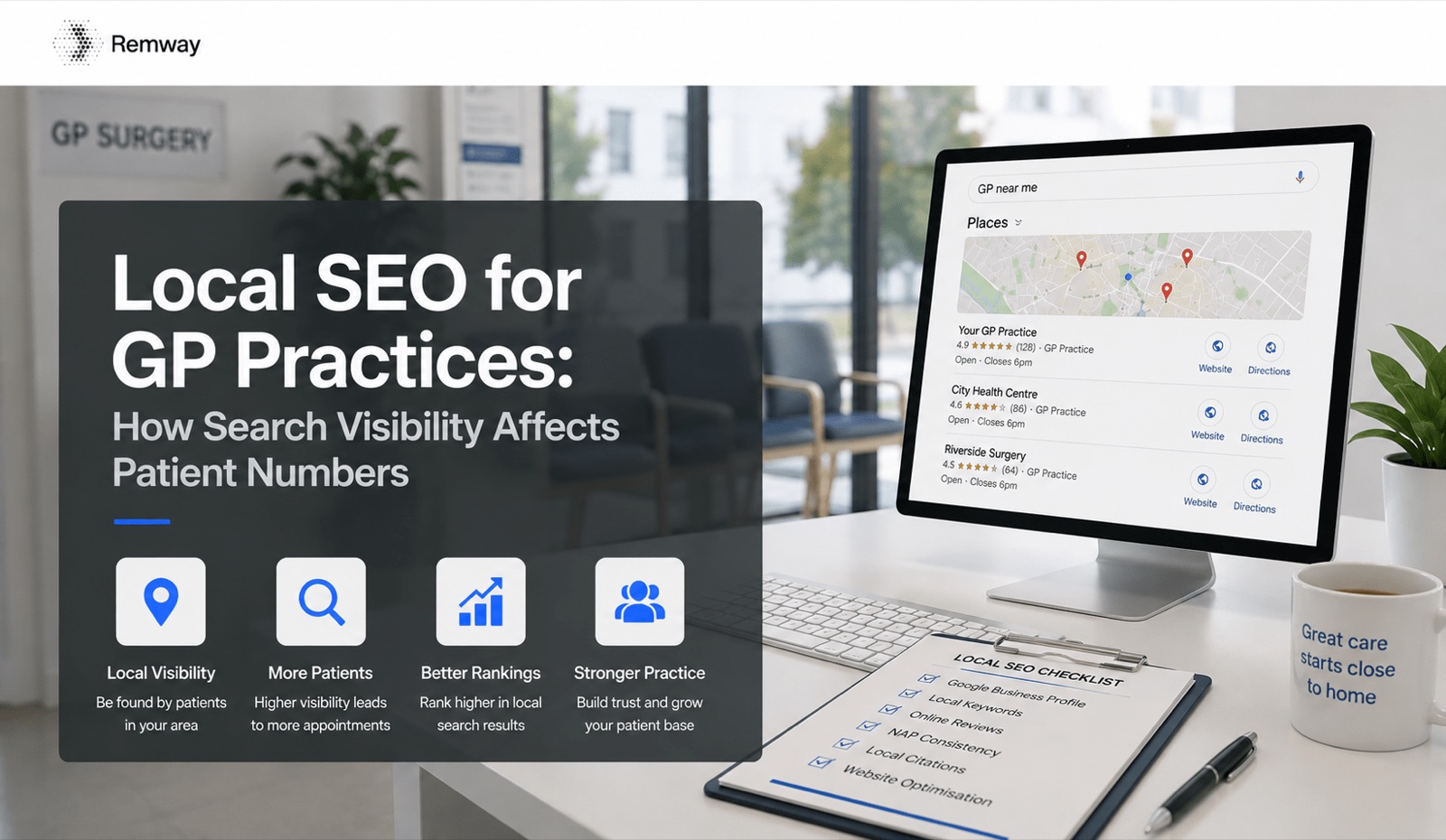
Your Google Business Profile is the box that appears when someone searches your practice name or “GP near me.” It shows your address, phone number, opening hours, and a link to your website. If this profile is unclaimed, incomplete, or out of date, patients see the wrong information. That leads to wasted calls, missed registrations, and patient frustration.
Your practice website matters because Google uses it to understand what services you offer and who you serve. A clear, well-structured site helps your practice appear for the right searches. Additionally, AI search assistants like ChatGPT, Perplexity, and Google’s AI Overview now summarise practice information directly in search results. If your website and profile are clear and accurate, those tools are more likely to surface your practice correctly. For a deeper look at how AI search now affects visibility alongside traditional search, the SEO for GP practices complete guide covers both in detail.
The Three Pillars of GP Practice Search Visibility
| Pillar | What It Is | Why It Matters |
|---|---|---|
| Google Business Profile | Free listing showing hours, location, phone, services | First thing patients see in local search results |
| Practice Website | Your online home for services, team info, and patient guidance | Helps Google and AI tools understand what your practice offers |
| AI Search Visibility | How AI assistants describe your practice in generated answers | Growing source of patient-facing information in 2026 |
Local SEO for GP Practices and the Link to Administrative Load
Local SEO for GP practices is not just about marketing. It has a direct effect on the volume and type of calls your reception team handles each day. When patients can find accurate, clear answers online, they make fewer unnecessary calls to the practice.
Think about the calls your team receives every day that could be answered by clear information on your website or Google Business Profile: opening hours, how to register, whether walk-ins are accepted, how to request a repeat prescription, or what to do if the surgery is closed. These are avoidable contacts. They take time, and they add pressure to an already stretched reception team.
Practices that publish clear, well-organised answers to common patient questions online tend to see a reduction in low-value inbound calls. Patients self-serve online instead of calling to ask. This matters particularly for triage-related queries. Patients searching “when should I see a GP for a cough” or “is a high temperature an emergency” are looking for guidance. If your site or Google listing provides that guidance, the patient gets what they need without necessarily needing to call at all. The practice manager’s guide to growing a GP patient list explores how content and visibility work together to support patient access.
- Clear opening hours online reduce calls asking “are you open today?”
- Published registration guidance reduces calls from prospective patients
- Service information online reduces calls to check what the practice offers
- Symptom guidance content can reduce unnecessary urgent appointment requests
Simple First Steps Any Practice Manager Can Take
Local SEO for GP practices does not require technical knowledge or a marketing budget to get started. There are a small number of actions that any practice manager can take without specialist support.
First, claim your Google Business Profile if you haven’t already. Visit Google Business Profile and search for your practice. If it’s unclaimed, you can verify and take ownership of it. This is free and takes less than an hour. Once claimed, make sure your opening hours, phone number, address, and website link are completely accurate.
Second, check that the information on your website matches your Google profile exactly. Inconsistencies confuse both patients and search engines. If your website says you open at 8am but your Google profile says 8:30am, neither source feels trustworthy.
Third, make sure your website has a clear page for new patient registration and a simple list of the services your practice offers. These are among the most searched topics for any GP surgery, and having clear, easy-to-find answers significantly improves your search visibility.
- Claim and verify your Google Business Profile
- Make sure opening hours are accurate and consistent across all platforms
- Add a clear registration page and services list to your website
- Include your practice address in the same format everywhere it appears
Where Local SEO for GP Practices Becomes a Bigger Project
Local SEO for GP practices at a single-site level is manageable as a DIY project with the steps above. However, the picture becomes more complex for PCNs, federations, or practices with multiple locations.
Each site needs its own Google Business Profile, its own consistent information, and ideally its own locally relevant web content. Managing this across five, ten, or more sites manually is time-consuming and prone to error. Outdated hours or wrong phone numbers across multiple listings create patient confusion at scale, and the reputational and administrative consequences multiply accordingly.
Additionally, ongoing content needs grow quickly. Answering common patient questions through well-written, human-reviewed articles requires consistent effort. AI search assistants now surface this kind of content directly in answers, which means the quality and accuracy of what you publish matters more than it did even a year ago. According to NHS England’s digital tools guidance, clear and accessible patient-facing information is increasingly central to primary care quality standards.
For PCN-wide visibility or multi-site content, practices generally need either a dedicated resource or a partner who understands both healthcare and search. Remway works specifically with GP practices and primary care organisations to publish credentialed, clinically-reviewed content that performs well in both Google and AI search. If you’re managing more than one site, or simply don’t have capacity to keep content updated, it’s worth understanding what a structured approach looks like.
Frequently Asked Questions
Does Google Business Profile matter for a GP practice?
Yes, Google Business Profile matters significantly for a GP practice. It is the first thing most patients see when they search for your surgery by name or by location. An incomplete or unclaimed profile shows outdated information, which leads to patient confusion and avoidable calls. Claiming and completing it is the single most impactful free action a practice can take for local search visibility.
Can better search visibility reduce phone calls to a practice?
Better search visibility can reduce avoidable phone calls when it gives patients the information they were going to call about. Opening hours, registration guidance, service lists, and basic clinical information published clearly online allow patients to self-serve. This reduces low-value inbound contact and frees up reception time for calls that genuinely need a human response.
Do patients really search online before contacting a GP?
Yes, patients regularly search online before contacting a GP. They search for opening hours, registration availability, services, and symptom-related questions. This behaviour has grown as smartphones have become the default way most people access information. Local SEO for GP practices ensures your surgery appears accurately when these searches happen, rather than leaving patients with incomplete or incorrect results.
What is the easiest first step for a practice with no marketing support?
The easiest first step is claiming your Google Business Profile at business.google.com. It is free and requires no technical knowledge. Once claimed, check that your opening hours, phone number, and address are completely accurate. Then make sure those same details appear consistently on your practice website. These two actions alone improve your local search visibility meaningfully and cost nothing except time.
Does AI search affect how patients find GP practices?
AI search tools like ChatGPT, Perplexity, and Google’s AI Overview increasingly answer patient questions directly, sometimes without the patient clicking through to a website. These tools pull information from practice websites and listings. If your information is clear, accurate, and well-structured, you are more likely to be surfaced correctly in these AI-generated answers, which is a growing part of how patients find and evaluate local healthcare services.