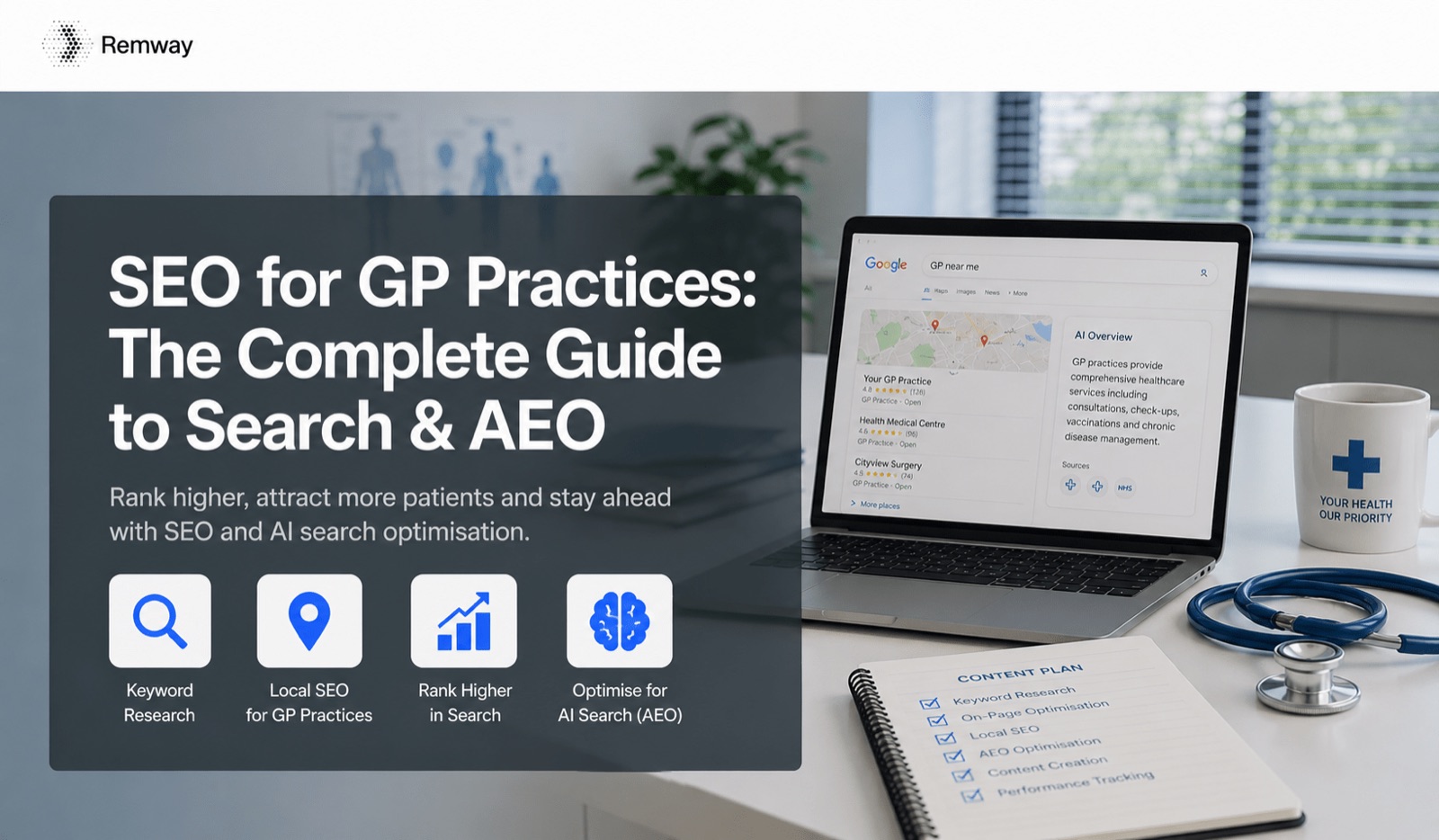
SEO for GP practices is no longer optional. Two forces are converging at once. First, practice funding is tied directly to patient list size — the more registered patients you have, the more resource your practice receives. Second, patients are increasingly asking AI chatbots health questions before they ever contact a surgery. If your practice website doesn’t appear in Google results or in AI-generated answers, patients may simply choose a different practice. This guide explains what to do, in plain language, starting from the beginning.
What Are the Two Channels That Now Judge Your Practice Online?
GP practices are now evaluated across two distinct digital channels: traditional search engines like Google, and AI answer engines like ChatGPT, Perplexity, and Google’s AI Overviews. Each channel works differently, and each one influences whether a prospective patient finds your practice or someone else’s.
Search Engine Optimisation (SEO) is the practice of making your website visible in Google’s ranked results. When someone searches “GP surgery accepting new patients in [town]”, Google decides whose site to show first. Practices with clear, well-structured, regularly updated websites tend to rank higher. Therefore, your website content directly affects how many patients discover you organically.
Answer Engine Optimisation (AEO) is newer. AI tools like ChatGPT and Perplexity don’t show a ranked list — they generate a direct written answer and cite the sources they drew from. If your practice website answers patient questions clearly and credibly, AI engines are more likely to cite it. For a deeper look at how these two channels compare, see SEO vs AEO: Key Differences Every Marketer Should Know.
Furthermore, NHS England’s guidance on GP practice choice confirms that patients have the right to register with any practice, not just the nearest one. That means your online presence actively competes for patients across a wider area than you might expect.
SEO for GP Practices: What Good Website Content Actually Looks Like
Good practice website content is answer-led, consistent, and credentialed — meaning it directly addresses the questions patients are already searching for, published on a regular schedule, and clearly attributed to a named clinician or reviewer. These three qualities determine whether Google ranks your content and whether AI engines trust it enough to cite.
Answer-Led Content
Answer-led content starts with the patient’s question, not the practice’s agenda. Instead of a page titled “Our Services”, a more effective page answers “What happens at a new patient registration appointment?” or “How do I get a same-day GP appointment?” These are real search queries that patients type. Content structured around real search queries earns impressions — the measure of how often your site appears in search results.
Consistent Publishing
Consistency matters more than volume. A practice that publishes two well-written, human-reviewed articles per month will outperform one that publishes twelve thin pieces at once and then goes quiet. Google rewards sites that are actively maintained. Additionally, AI engines tend to cite sources that are regularly updated rather than static pages.
Credentialed Authorship
Named authorship and clinical review are not optional extras for healthcare content. Google’s quality guidelines place health content under heightened scrutiny — it calls this “Your Money or Your Life” content, meaning inaccurate advice has real-world consequences. Credentialed content, with a named GP or clinician attached, signals trust to both Google and AI engines. For a full breakdown of how to grow your patient list through content, see Grow GP Practice Patient List: A Practice Manager’s Guide.
Why Are Patients Asking AI Before They Call the Surgery?
Patients are turning to AI answer engines first because AI gives an immediate, conversational response without hold music, a receptionist queue, or an appointment wait. This shift is already measurable. Research from King’s College London found that one in seven UK adults have used AI instead of contacting a GP. That figure suggests a significant and growing proportion of your potential patients are getting health information — and forming opinions about what to do next — from an AI tool before they ever interact with your practice.
This matters for SEO for GP practices in a very direct way. If a patient asks an AI chatbot “how do I register with a GP near me” and that AI cites your practice’s content as a source, your practice gains visibility and credibility. If your site has no relevant content, the AI cites a competitor or a generic NHS page, and your practice is invisible in that interaction.
Furthermore, patients who read your practice’s content before registering arrive better informed and with more realistic expectations. That has real benefits for appointment quality and patient experience. NHS.uk’s guidance on registering with a GP is currently one of the most-cited sources in AI responses on this topic — your practice content needs to be in the same conversation.
To understand how AI search visibility works technically, the guide What Is AI Search Visibility? Complete Guide for Brands explains the mechanics clearly.
What Is the Real Risk of Getting This Wrong?
Publishing unreviewed AI-generated health content is a patient safety risk, not just a quality concern. This is the point where practice managers need to be particularly careful. It is now straightforward to generate a healthcare article using an AI tool in under a minute. However, AI-generated health advice can be confidently worded and factually wrong at the same time.
A study published in The Lancet’s eClinicalMedicine journal examined the risks of AI-generated health advice and found meaningful concerns about accuracy and the potential for harm. Importantly, this research addresses the broader risk of AI health content — not a narrow UK or GP-specific finding. The concern applies wherever patients might act on health information that has not been clinically reviewed.
For a GP practice, the stakes are higher than for most organisations. If a patient reads content on your website and acts on incorrect information, the regulatory and reputational consequences fall on the practice. Therefore, every piece of patient-facing content your practice publishes must be written or reviewed by a credentialed clinician, clearly dated, and updated when guidance changes.
What Safe Practice Content Looks Like in Practice
Safe, publishable healthcare content has four characteristics. First, it carries a named clinical author or reviewer with their credentials stated. Second, it cites authoritative sources such as NICE guidelines or NHS guidance where relevant. Third, it is dated so patients know it is current. Fourth, it is reviewed and updated at a defined interval — typically annually for stable clinical topics, and sooner when guidance changes.
How Does GP Practice Funding Connect to Your Online Presence?
GP practice income is directly linked to patient list size, which means attracting and retaining registered patients has a financial dimension that goes beyond patient care. The King’s Fund’s explanation of GP funding and contracts sets out clearly how the core funding mechanism works: practices receive a weighted capitation payment per registered patient, adjusted for factors including age and deprivation. More registered patients means more resource — in principle, more staff, more appointments, more capacity.
SEO for GP practices therefore has a direct financial rationale. If prospective patients search for a GP surgery in your area and your practice does not appear in results — or if your website looks outdated and uninformative compared to a neighbouring practice — those patients may register elsewhere. That is a recurring revenue loss, not a one-off marketing miss.
Additionally, practices in areas with patient mobility — cities, areas with high student populations, or areas with new housing developments — are more exposed to this dynamic. Patients who move into an area and search online for a GP will make a choice based partly on what they find. Your website and your Google Business Profile are often the first impression a prospective patient has of your practice.
A Practical Starting Checklist for SEO for GP Practices
Starting SEO for GP practices does not require technical expertise — it requires a structured approach applied consistently over time. The checklist below covers the foundations a practice manager can action without an in-house digital team.
- Claim and complete your Google Business Profile. This is the single highest-impact action for local search visibility. Add your address, phone number, opening hours, patient registration status, and at least five recent photos. Keep this updated — especially if hours or registration status change.
- Identify the questions your patients actually ask. Start with reception. What do patients ask most often by phone or at the desk? Each of those questions is a content opportunity. Real search queries from real patients are the foundation of effective SEO for GP practices.
- Publish your first set of answer-led articles. Aim for five to ten articles covering your most common patient questions. Each article should open with the direct answer, be written in plain English, and carry a named clinician reviewer.
- Set a realistic publishing cadence. Two human-reviewed articles per month is a sustainable starting point for most practices. Consistency over time builds organic traffic and impressions more reliably than occasional bursts of content.
- Track your impressions in Google Search Console. Impressions show how often your site appears in search results, even when patients don’t click. Rising impressions over three to six months is the first sign that your content strategy is working. For practices also monitoring AI visibility, the Generative AI Performance Report guide explains what to track.
- Ensure named authorship and clinical review on every patient-facing article. This protects the practice, builds trust with patients, and signals credibility to both Google and AI answer engines.
A comparison of where most practices start versus where effective content strategy takes them may be helpful:
| Area | Typical Starting Point | Effective Practice Content Strategy |
|---|---|---|
| Google Business Profile | Unclaimed or incomplete | Claimed, complete, regularly updated |
| Website content | Static “About Us” and services pages | Answer-led articles updated on a schedule |
| Authorship | No named author or reviewer | Named GP or clinician reviewer on every article |
| Publishing cadence | Occasional, unplanned | Two credentialed articles per month, consistently |
| AI visibility | Not considered | Content structured for AI citation as well as Google ranking |
| Performance tracking | No tracking in place | Google Search Console impressions monitored monthly |
Frequently Asked Questions
What is AEO and how is it different from SEO?
SEO (Search Engine Optimisation) is the practice of making your website rank well in Google’s list of results. AEO (Answer Engine Optimisation) is the practice of structuring your content so that AI tools like ChatGPT or Perplexity cite it when generating a direct written answer to a patient’s question. Both matter. SEO drives clicks from a ranked list. AEO earns citations inside AI-generated responses, which is increasingly how patients get health information before they contact a practice.
Does website content really affect how many patients register with a GP practice?
Yes, it does. Patients have the right to register with any GP practice, not just their nearest. When a patient moves to a new area or decides to change practice, they often search online first. A practice with informative, well-structured website content and a complete Google Business Profile is more likely to appear in those searches. Over time, that search visibility translates into new patient registrations, which directly affects practice funding.
Is it safe to publish AI-generated content for patients?
AI-generated content is not safe to publish without clinical review. AI tools can produce health content that sounds authoritative but contains factual errors. Research published in The Lancet’s eClinicalMedicine journal has highlighted the risks of AI-generated health advice. For a GP practice, publishing unreviewed content creates patient safety risks and reputational exposure. All patient-facing content must be reviewed by a named, credentialed clinician before publication, regardless of how it was drafted.
How often should a GP practice publish new content?
Two human-reviewed articles per month is a practical and sustainable cadence for most practices. Consistency matters more than volume — a practice that publishes regularly over twelve months will build stronger search visibility than one that publishes in bursts. Each article should address a real patient question, carry a named reviewer, and be written in plain English. Over time, a growing library of credentialed content builds organic traffic and impressions across both Google and AI answer engines.
Can a PCN use one content strategy across multiple practices?
Yes, a PCN can develop a shared content strategy, but individual practice pages still need to reflect each practice’s location, services, and registration status. A central editorial process — where articles are written, clinically reviewed, and then adapted for each practice’s context — is an efficient approach. Shared authorship standards, a consistent publishing schedule, and coordinated Google Business Profile management across member practices can all be handled at PCN level without losing the local relevance each practice needs.