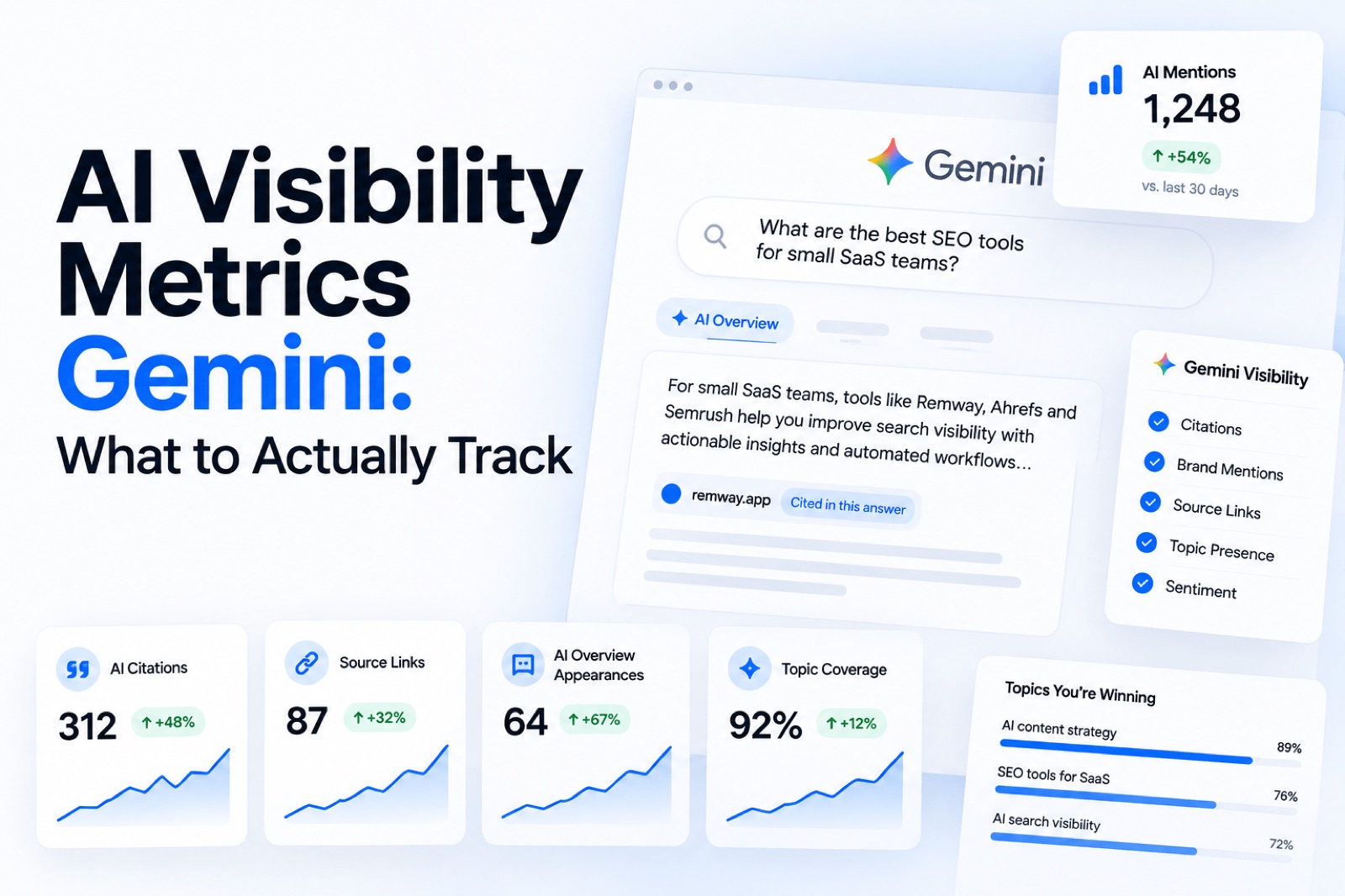
AI visibility metrics Gemini requires are fundamentally different from anything in your current SEO dashboard. There is no rank position. There is no impressions column. When Gemini answers a query with a generated paragraph, your brand either appears in that answer or it does not. Traditional SEO tooling cannot tell you which. This guide names the actual metrics worth tracking, explains how to collect them, and shows you how to build a baseline that moves from guesswork to measurement. If you are serious about Google Gemini AI visibility, start here.
Why Gemini Visibility Cannot Be Measured with SEO Metrics
Gemini search visibility means the frequency and quality with which Google’s generative AI engine includes your brand in its generated responses to relevant queries. That definition matters because it immediately shows why standard SEO metrics fall short. Average position assumes a ranked list of ten blue links. CTR assumes someone clicked. Impressions assume a URL was shown. Gemini often produces none of those signals.
Furthermore, Google Search Console does not currently report on generative AI answer appearances separately from organic results. So even if your site is cited inside a Gemini answer, you may see zero measurable lift in GSC impressions for that query. The measurement gap is real, and it is structural.
For context on how SEO vs AEO differ in practice, the core shift is this: SEO measures where you rank, AEO measures whether you are trusted enough to be cited. Those require completely different measurement frameworks. The metrics below are built around that distinction.
AI Visibility Metrics Gemini Marketers Should Track
AI visibility metrics Gemini produces fall into five concrete categories. Each one maps to something you can actually observe by querying Gemini directly and recording what it returns. Here is each metric defined, with a note on what good looks like.
Mention Rate
Mention rate is the percentage of relevant queries in your prompt set where Gemini includes your brand name in the generated response. If you run 40 prompts and your brand appears in 14 answers, your mention rate is 35%. Good varies by market size. In a niche B2B category, a 40–50% mention rate is strong. In a broad category with many established players, 15–25% may already put you ahead of most competitors.
Citation Share
Citation share measures how often your website URL is included as a source link within Gemini’s grounded responses. Gemini uses two modes: grounded responses, which pull from live web content and display source links, and non-grounded responses, which generate from training data alone. Citation share only applies to grounded mode. Therefore, tracking it alongside mention rate gives you a fuller picture — you may be mentioned without being cited, or cited without being mentioned by name.
Sentiment and Framing When Cited
Framing score captures how Gemini describes your brand when it does appear. Is your product described accurately? Is it positioned as a recommended option, a secondary alternative, or a cautionary example? You score each mention as positive, neutral, or negative. Over time, a shift in framing — even with stable mention rate — signals that your brand narrative is drifting in the model’s understanding of your category.
Co-Mention with Competitors
Co-mention rate tracks how often your brand appears in the same response as named competitors. This tells you whether Gemini places you inside the competitive consideration set. If a competitor appears in 80% of responses and you appear in 30%, but you co-appear together in only 10%, Gemini is not yet treating you as a like-for-like alternative. That is a positioning gap, not just a visibility gap.
Query Coverage
Query coverage is the breadth of your prompt set where your brand achieves any mention. You may have strong mention rate on product-comparison queries but zero presence on problem-awareness queries. Mapping coverage by query type reveals which stages of the buying journey Gemini associates your brand with — and which it does not.
How to Collect AI Visibility Metrics Gemini Produces
AI visibility metrics Gemini returns can only be collected through direct, structured prompt sampling. There is currently no API endpoint that exposes brand mention data from Gemini’s generative answers. That means manual or semi-automated prompt sets are the only reliable method.
Building Your Prompt Set
Start with 30–50 prompts that reflect real queries your target audience asks. Group them by intent: problem-awareness queries, category comparison queries, product-specific queries, and use-case queries. Avoid branded queries — you want to measure organic, unprompted inclusion. A strong prompt set covers multiple query types so that query coverage becomes a meaningful metric rather than a single number.
Sampling Frequency and Why One-Off Checks Fail
A single snapshot of Gemini’s responses is nearly worthless. Gemini’s outputs vary across sessions, update with new grounding data, and shift as Google adjusts its generative systems. Therefore, run your full prompt set at a consistent cadence — weekly for fast-moving categories, bi-weekly for stable ones. Record every output. The signal you are looking for is directional movement over four to eight weeks, not a single data point.
Grounding vs Non-Grounding Distinction
When Gemini displays source links beneath a response, it is operating in grounded mode, drawing from live web content. When it generates a response with no sources shown, it is drawing from its training data. These two modes require separate interpretation. A mention in grounded mode means your published content influenced the answer directly. A mention in non-grounded mode means your brand has sufficient training-data presence to appear without a live content pull. Both matter. Track them separately in your log.
Worked Example: Calculating Mention Rate
Here is a concrete example. Suppose you run 40 prompts across four intent categories — ten per category. You record each Gemini output and note whether your brand appears. Results: 6 appearances in problem-awareness prompts, 4 in category-comparison prompts, 3 in product-specific prompts, and 1 in use-case prompts. Total appearances: 14 out of 40 prompts. Mention rate: 35%. Query coverage by type shows strong problem-awareness presence but weak use-case coverage. That tells you exactly where to focus your next round of content — use-case content that ties your product to specific outcomes Gemini can cite.
Building a Baseline and Reading Movement Over Time
Building a baseline for AI visibility metrics Gemini tracks requires at least three consistent sampling rounds before the numbers mean anything. Your first round sets the starting point. Your second round confirms whether the first was representative or an outlier. Your third round begins to show direction. Only at that point can you reasonably say your metrics are moving up, down, or holding.
Use a simple tracking table to record each weekly run. Log mention rate, citation share, framing score distribution, co-mention rate, and query coverage breakdown side by side. Movement of five percentage points or more in mention rate over four weeks is worth investigating. A sudden drop in citation share often correlates with a content change — a page being deindexed, a URL redirect, or a significant rewrite that altered how Gemini interprets your content.
| Metric | What It Measures | Tracking Method | What Good Looks Like |
|---|---|---|---|
| Mention Rate | % of prompts where brand appears | Manual prompt sampling | 35%+ in niche B2B categories |
| Citation Share | % of grounded responses with your URL | Grounded-mode prompt runs | Consistent presence across product queries |
| Framing Score | Sentiment of brand description when cited | Manual review and scoring | Predominantly positive or neutral |
| Co-Mention Rate | Frequency of appearing alongside competitors | Prompt set cross-referencing | High overlap with top competitors |
| Query Coverage | Breadth of query types with brand presence | Intent-grouped prompt sets | Presence across all buying journey stages |
Additionally, compare your metrics against a consistent competitor set. Track two or three named competitors using the same prompt set. This gives you relative share-of-voice data inside Gemini’s answer space, which is far more actionable than an absolute number in isolation. For a broader view of how to build this kind of measurement into a repeatable system, understanding what AI search visibility means across all generative platforms provides useful grounding.
What to Do When Your AI Visibility Metrics Gemini Shows Are Low
AI visibility metrics Gemini reflects poorly when your content does not match the format, authority signals, or topical depth that generative models prefer. Low mention rate usually points to one of three problems: your content does not clearly answer the queries in your prompt set, your brand lacks third-party mentions that Gemini can use as corroboration, or your content is too thin to be extracted as a reliable source.
For each problem, the fix is different. Thin content requires rewriting pages to include direct definitions, concrete examples, and clear category positioning. Lack of third-party mentions requires a broader digital PR or thought-leadership effort so that other sites reference your brand in relevant contexts. Poor query alignment requires building new content around the specific query types where your coverage is weakest.
Furthermore, framing problems — where Gemini mentions you but positions you inaccurately — are often fixed by updating your own pages to state your positioning more explicitly. Gemini frequently pulls descriptive language directly from your content. If your homepage calls you a “content planning tool,” that is likely how Gemini describes you. Update the language on your highest-authority pages and monitor whether framing scores improve over the following two to three sampling rounds.
For a full set of tactical recommendations on improving these numbers, the AI search visibility best practices guide covers the practical steps in detail. You can also find a useful comparison of AI visibility tools if you want to evaluate tooling options for scaling this measurement process.
Frequently Asked Questions
What are AI visibility metrics Gemini marketers should start with?
AI visibility metrics Gemini tracking should start with mention rate and query coverage. Mention rate tells you how often your brand appears across a structured prompt set. Query coverage tells you which intent types are covered. These two metrics together give you the most actionable starting picture without requiring complex tooling. Build a 30–40 prompt set grouped by intent, run it weekly, and record every result consistently from the first session.
Does Google Search Console show Gemini visibility data?
Google Search Console does not currently provide separate reporting for generative AI answer appearances. GSC reports clicks and impressions for traditional organic results. If Gemini cites your content in a generated answer and a user does not click through, that interaction leaves no trace in Search Console. Therefore, direct prompt sampling remains the only reliable method for measuring how often your brand appears inside Gemini’s generated responses.
How is citation share different from mention rate in Gemini?
Mention rate measures how often your brand name appears anywhere in a Gemini response. Citation share measures how often your website URL is shown as a source link in grounded Gemini responses specifically. A brand can have a high mention rate from training-data knowledge but a low citation share if its published content is not being pulled in grounded mode. Tracking both separately helps you understand whether your content or your broader brand presence is driving Gemini appearances.
How often should I run Gemini prompt sets?
Run your full prompt set weekly for fast-moving categories or bi-weekly for more stable ones. Single one-off checks are not useful because Gemini’s outputs vary across sessions and update as Google refreshes its grounding data. You need at least three consistent rounds before you have a reliable baseline. Direction of movement over four to eight weeks is the signal worth reading, not any individual session’s results.
What does a low framing score mean for my brand?
A low framing score means Gemini is describing your brand inaccurately, as a secondary option, or in a context that does not match your intended positioning. This often happens because the descriptive language on your highest-authority pages does not clearly state your positioning. Gemini frequently pulls language directly from your own content. Updating your page copy to be more explicit about your category, audience, and use case is usually the fastest way to shift framing scores over subsequent sampling rounds.