To prioritise SEO content ideas effectively, you need a clear framework based on real search data, not guesswork. Many website owners pick topics based on what feels right or what competitors appear to write about. However, that approach wastes time and produces content that rarely attracts the right audience. Therefore, this guide shows you a practical, data-led method for choosing which article ideas deserve your time first.
Why It Matters to Prioritise SEO Content Ideas
Publishing content randomly rarely produces consistent organic traffic growth. First, high-volume keywords are not always the best starting point. Additionally, new websites need realistic opportunities that can actually generate impressions and clicks within a reasonable timeframe. Furthermore, every article you publish should support a specific business goal, not just fill a content calendar.
Search data should guide your content roadmap from the start. For example, if your Google Search Console data shows queries with impressions but low CTR, those topics already have proven demand. Consequently, acting on that data is far more effective than writing broadly about a topic and hoping it performs.
- Publishing randomly wastes time and budget
- High-volume keywords are often too competitive for newer sites
- Content should connect directly to your product or service
- Search data removes guesswork from your content planning
- A clear priority order makes your SEO workflow more efficient
What Makes a Good SEO Content Idea?
First, a strong SEO content idea is directly relevant to your business and audience. Additionally, it should have clear search intent, meaning you understand exactly why someone is searching for that topic. A good idea also has real search demand, even if the volume is modest. Moreover, it should be a topic where you can realistically rank and provide a more useful answer than existing results.
Similarly, the best ideas support your product or service naturally. They attract readers who are likely to become customers, subscribers, or engaged followers. In contrast, generic topics with broad appeal often attract visitors who have no interest in what you offer.
- Clearly relevant to your business or audience
- Has identifiable search intent
- Shows real search demand in Search Console or keyword tools
- Possible to rank for based on your site’s current authority
- Can support a product, service, or conversion goal
- Can be answered more usefully than current top results
A Simple Framework to Prioritise SEO Content Ideas
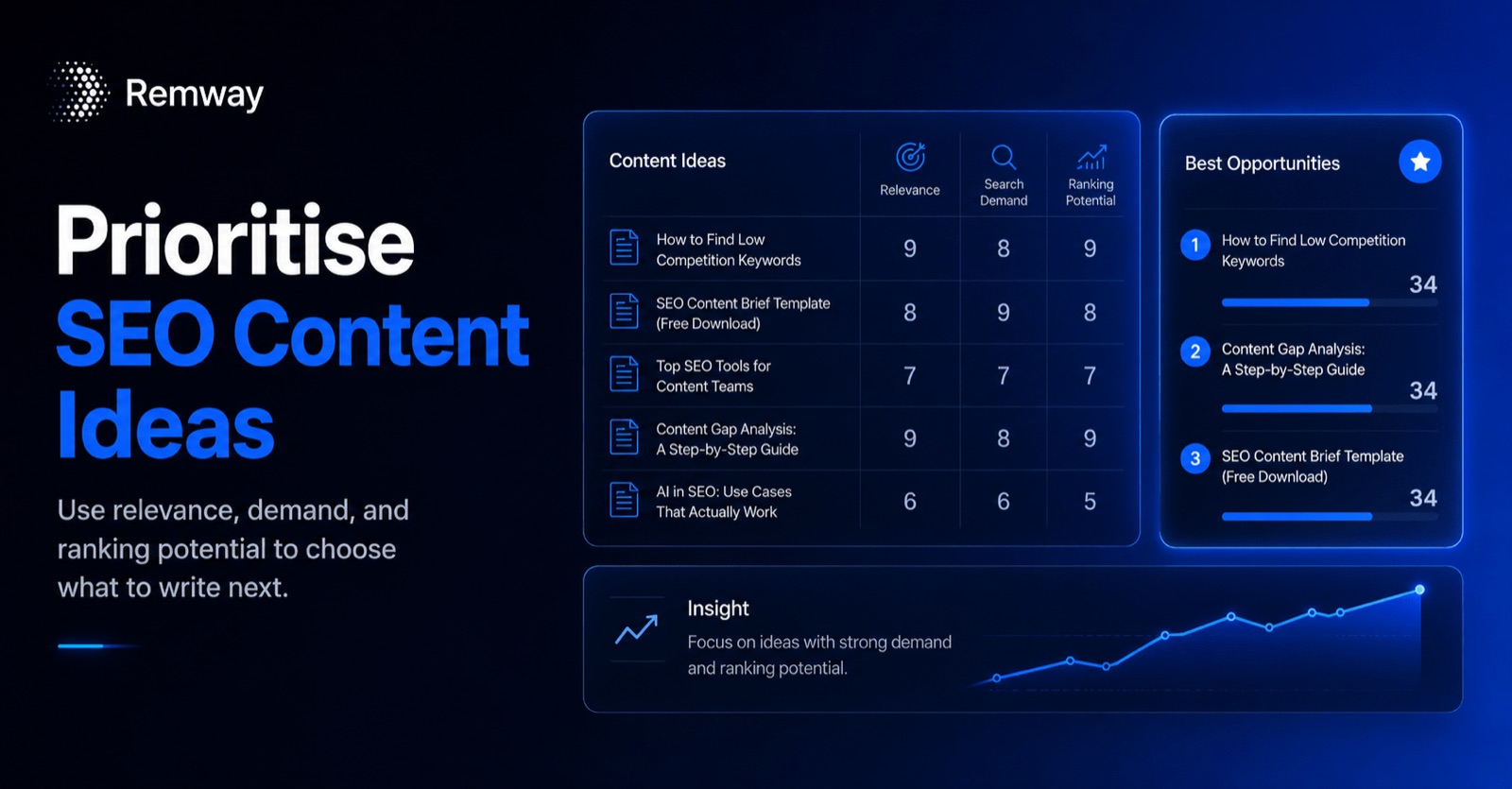
Therefore, use a scoring framework to evaluate each idea objectively. Score each criterion from one to five. Then, add the scores together and prioritise the ideas with the highest totals. This approach removes bias and helps you make faster, smarter content planning decisions.
| Criteria | Question to Ask | Score (1–5) |
|---|---|---|
| Business relevance | Does this topic connect to what we sell or offer? | 1–5 |
| Search demand | Are real people searching for this query? | 1–5 |
| Ranking potential | Can we realistically rank for this on our current site? | 1–5 |
| Conversion potential | Could this article lead someone toward a product or service? | 1–5 |
| Search intent clarity | Is it clear what the reader wants to find? | 1–5 |
| Content quality potential | Can we write something genuinely better than existing results? | 1–5 |
As a result, any idea scoring above 20 out of 25 is worth writing soon. Ideas scoring between 12 and 19 are worth developing later. Moreover, ideas below 12 should either be reworked or deprioritised entirely.
How to Apply This Scoring in Practice
Score each idea independently before comparing them. Additionally, involve anyone on your team who understands both your audience and your product. Above all, be honest about your ranking potential. A score of five for ranking potential means you believe you can compete for that term today, not eventually.
How to Use Google Search Console to Prioritise SEO Content Ideas
Google Search Console is one of the most useful tools available for smarter content planning. First, look for queries in your performance report that have strong impressions but low CTR. These topics already show demand, but your current content is not capturing clicks effectively. Therefore, creating a dedicated, well-structured article for that query is a high-priority opportunity.
Second, look for keywords where your pages rank in positions eleven to twenty. These are page two rankings. Consequently, a focused article on that topic could move you onto page one with relatively modest effort. Similarly, look for clusters of related queries that point toward a single underlying topic your site has not fully covered yet.
- Find queries with impressions but low CTR
- Identify page two keywords to target with new content
- Group related queries into topic clusters
- Find search queries directly connected to your product or service
- Use average position data to identify where small improvements are realistic
For a deeper walkthrough, read our guide on how to find content opportunities in Google Search Console.
How to Prioritise Ideas for a New Website
New websites face a specific challenge. Furthermore, competing for broad, high-volume keywords from the start is rarely effective. Instead, focus on long-tail queries that describe specific problems or niche questions. These topics have lower competition and are far more likely to generate early impressions and clicks.
Additionally, product-adjacent education works well for new sites. For example, if you sell an SEO tool, writing about how to read Search Console data attracts people already looking for solutions like yours. Moreover, building a topic cluster early, where several supporting articles link back to a single pillar page, helps search engines understand what your site is about.
- Start with long-tail, specific queries rather than broad topics
- Write about problems your product or service directly solves
- Build supporting articles that connect to a core pillar page
- Choose topics with low competition and clear search intent
- Pick topics that can generate impressions before high-volume terms become realistic
Example: Choosing Between Five SEO Article Ideas
To make this practical, consider the following five article ideas for a new SEO tool website. Each idea is relevant, but not all are equally worth prioritising right now.
| Article Idea | Relevance | Difficulty | Best for New Site? | Why |
|---|---|---|---|---|
| What is SEO? | Low | Very high | No | Extremely competitive, low conversion potential |
| Best SEO tools | Medium | High | No | Dominated by established review sites |
| Google Search Console impressions but no clicks | High | Low | Yes | Specific problem, clear intent, low competition |
| How to find page two keywords | High | Low | Yes | Practical topic, strong conversion potential |
| SEO content opportunities | Very high | Medium | Yes | Directly supports product positioning and cluster strategy |
As a result, the last three ideas are clearly better starting points. They are specific, they connect directly to the product, and they match the search intent of a reader already looking for practical SEO help. In contrast, writing about broad topics like “what is SEO” first is unlikely to generate meaningful organic traffic for a new site.
How Remway Helps You Prioritise SEO Content Ideas
Remway connects to your Google Search Console account and surfaces real content opportunities from your actual search data. First, it identifies queries with impressions, low CTR, and ranking gaps that represent realistic wins. Additionally, it groups those queries into article ideas that match your brand voice and business goals.
Therefore, instead of manually reviewing hundreds of rows of search data, Remway highlights the most relevant opportunities automatically. Furthermore, it helps you move from identifying an idea to producing an SEO-ready article faster than a traditional content planning workflow allows. As a result, your content strategy becomes data-led rather than opinion-based.
Common Mistakes to Avoid When You Prioritise SEO Content Ideas
Many teams make the same avoidable mistakes when organising their content roadmap. First, chasing only high-volume keywords is one of the most common errors. Additionally, ignoring business relevance leads to content that generates traffic but no conversions. Moreover, creating thin articles that do not fully answer the reader’s question wastes both your time and your audience’s attention.
- Chasing high-volume keywords that are too competitive for your current site
- Ignoring business relevance when choosing topics
- Writing content that cannot lead to any conversion or business outcome
- Publishing thin articles without depth or genuine usefulness
- Failing to build a topic cluster around your most important themes
- Ignoring Google Search Console data in favour of guesswork
- Not reviewing article performance after publishing to refine future decisions
Consequently, avoiding these mistakes makes your SEO workflow more focused and your content more effective. Above all, consistency and relevance matter more than publishing volume.
Frequently Asked Questions
How do I prioritise SEO content ideas?
To prioritise SEO content ideas, score each topic across six criteria: business relevance, search demand, ranking potential, conversion potential, search intent clarity, and content quality potential. Use a simple one-to-five scoring system. Additionally, review your Google Search Console data for queries with impressions but low CTR. Therefore, focus first on ideas that score highest and connect directly to your product or service.
Should I choose high-volume or low-competition keywords?
For most websites, especially newer ones, low-competition keywords are the better starting point. High-volume keywords are often dominated by established sites with strong authority. In contrast, specific long-tail queries with clear search intent offer a more realistic path to organic traffic. Furthermore, low-competition keywords often attract readers closer to making a decision, which means higher conversion potential.
What content should a new website publish first?
A new website should first publish content targeting specific, long-tail queries with clear search intent and low competition. Additionally, focus on topics directly related to your product or service. For example, write about the specific problems your audience is searching for solutions to. Moreover, building a small cluster of supporting articles around a central topic helps search engines understand your site’s relevance faster.
How many SEO articles should I publish per week?
There is no single correct answer. However, publishing one well-researched, genuinely useful article per week is far more effective than publishing thin content daily. Quality and relevance matter more than volume. Additionally, each article should serve a clear purpose in your content strategy. Therefore, focus on fewer, higher-quality pieces that match real search demand and support your business goals.
How do I know if an article idea is worth writing?
An article idea is worth writing when it scores well across business relevance, search demand, ranking potential, and conversion potential. Additionally, check whether real people are searching for that topic using Google Search Console or a keyword research tool. Furthermore, assess whether you can write something more useful than existing results. If the answer to those questions is yes, the idea is worth prioritising.
Can Remway help prioritise SEO content ideas?
Yes. Remway uses your actual Google Search Console data to surface content opportunities based on impressions, clicks, average position, and CTR. Therefore, instead of manually sifting through search data, Remway highlights the most relevant article ideas for your site. Additionally, it helps you turn those opportunities into SEO-ready articles that match your brand voice and support long-term website growth.