Guides and resources

SEO and AEO guides for founders and small teams

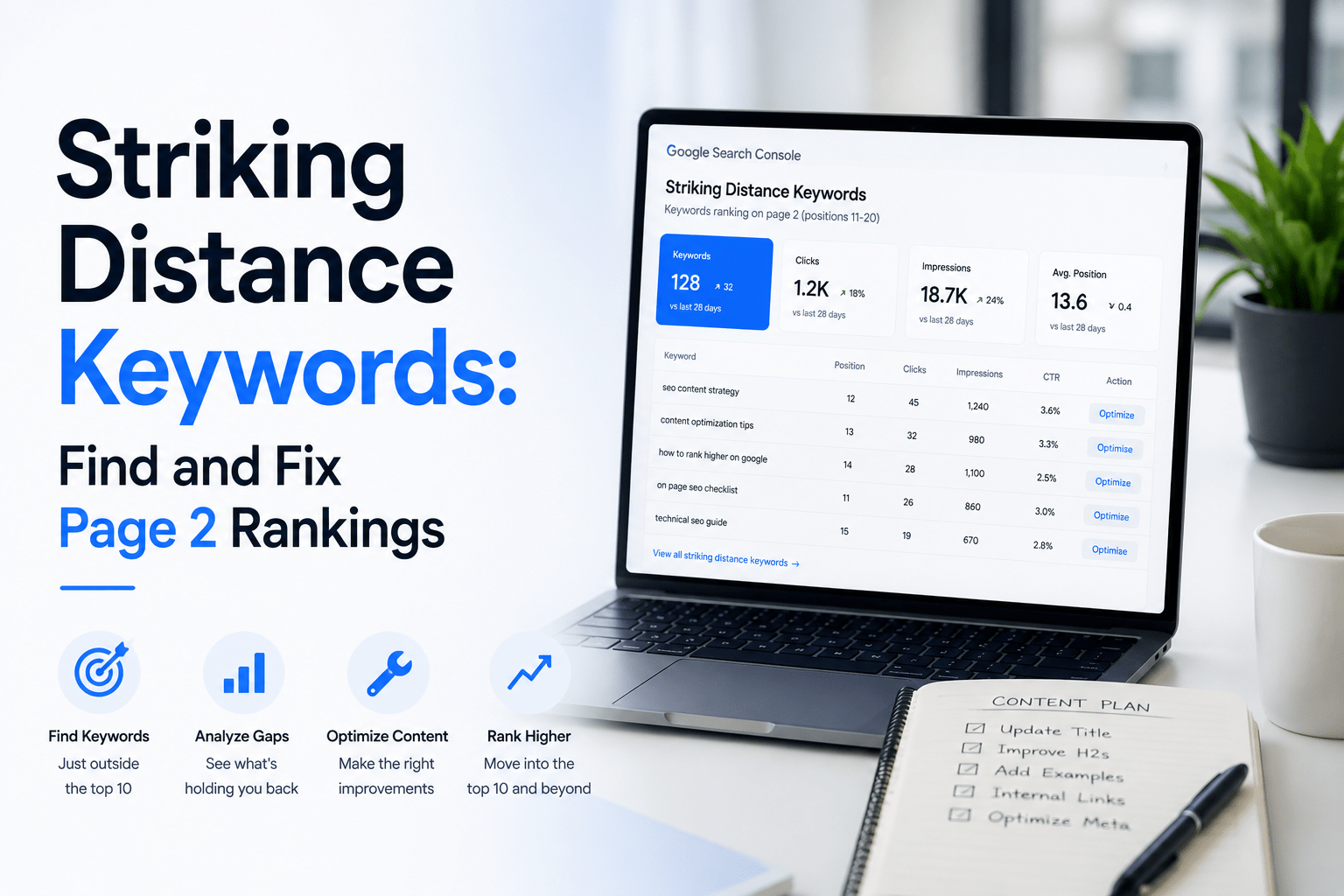
Answer Engine Optimisation (AEO), also called Generative Engine Optimisation (GEO), is the practice of structuring content so AI engines like ChatGPT, Perplexity, and Gemini cite your brand in their answers. These guides cover both AEO and traditional SEO: how to read your Search Console data, find the keywords you are closest to ranking for, and turn them into articles that rank on Google and get quoted by AI.

Written for founders and small teams with no dedicated content person. Practical, specific, and based on what has actually worked for Remway clients rather than general theory.

Have a question, or want to suggest a topic for a future guide? Book a call and speak with me directly.

All articles

Frequently asked questions

Everything you need to know about Remway, SEO, and AI visibility.

What is Answer Engine Optimisation (AEO)?

Answer Engine Optimisation is the practice of structuring content so AI engines cite your brand in their answers. Where SEO targets Google’s ranked list of links, AEO targets the generated response itself, in ChatGPT, Perplexity, Gemini, and Google AI Overviews. AEO content uses direct answers, clear question-and-answer structure, named entities, and cited external sources, because AI engines preferentially cite what they can verify.

What is the difference between SEO and AEO?

SEO gets you ranked. AEO gets you quoted. SEO optimises for position in a list of ten links. AEO optimises for inclusion in an AI-generated answer, where there is no list, usually just three to five cited sources. The underlying work overlaps heavily, since both reward structured, authoritative, consistently published content. AEO simply puts more weight on answering directly, citing sources, and making your brand identifiable as an entity 

How do I get my brand cited by ChatGPT or Perplexity?

To get cited by AI engines, publish content that is easy to verify and easy to extract. That means answering the question directly in the first sentence, naming specific entities rather than speaking in generalities, citing authoritative external sources, and publishing consistently enough that engines associate your brand with a topic. One good article rarely earns a citation. A sustained body of verifiable content does.

How do you measure AEO performance?

AEO is measured by citation frequency, not by ranking position. You query AI engines with topic-relevant prompts on a schedule and record how often your brand appears in the answers and which pages get cited. The useful signals are your share of citations against competitors, which topics you appear for, and whether that trend is rising. Traditional rank tracking cannot see any of this, because AI answers are generated per query rather than served from a fixed index.

Does Remway help with AEO?

Yes. Every article Remway generates is structured for AEO by default: a direct answer in the opening paragraph, question-and-answer sections, cited external sources, entity-rich language, and a clean heading hierarchy. Remway also tracks whether your brand is actually appearing in ChatGPT, Perplexity, and Gemini responses over time, so you can see AEO working rather than assume it is. 

Do I still need SEO if AI search is growing?

Yes. Google still handles the large majority of searches, and AI engines are heavily grounded in web results, so pages that rank well are disproportionately the ones that get cited. The two are not separate channels competing for your effort. Ranking on Google is one of the strongest inputs into whether an AI engine finds and quotes you, which is why AEO works best layered onto solid SEO rather than replacing it.

Your competitors are publishing.
Start today

Book a 30-minute call and we’ll show you exactly how Remway builds your visibility across Google and AI search, from keyword to citation.