
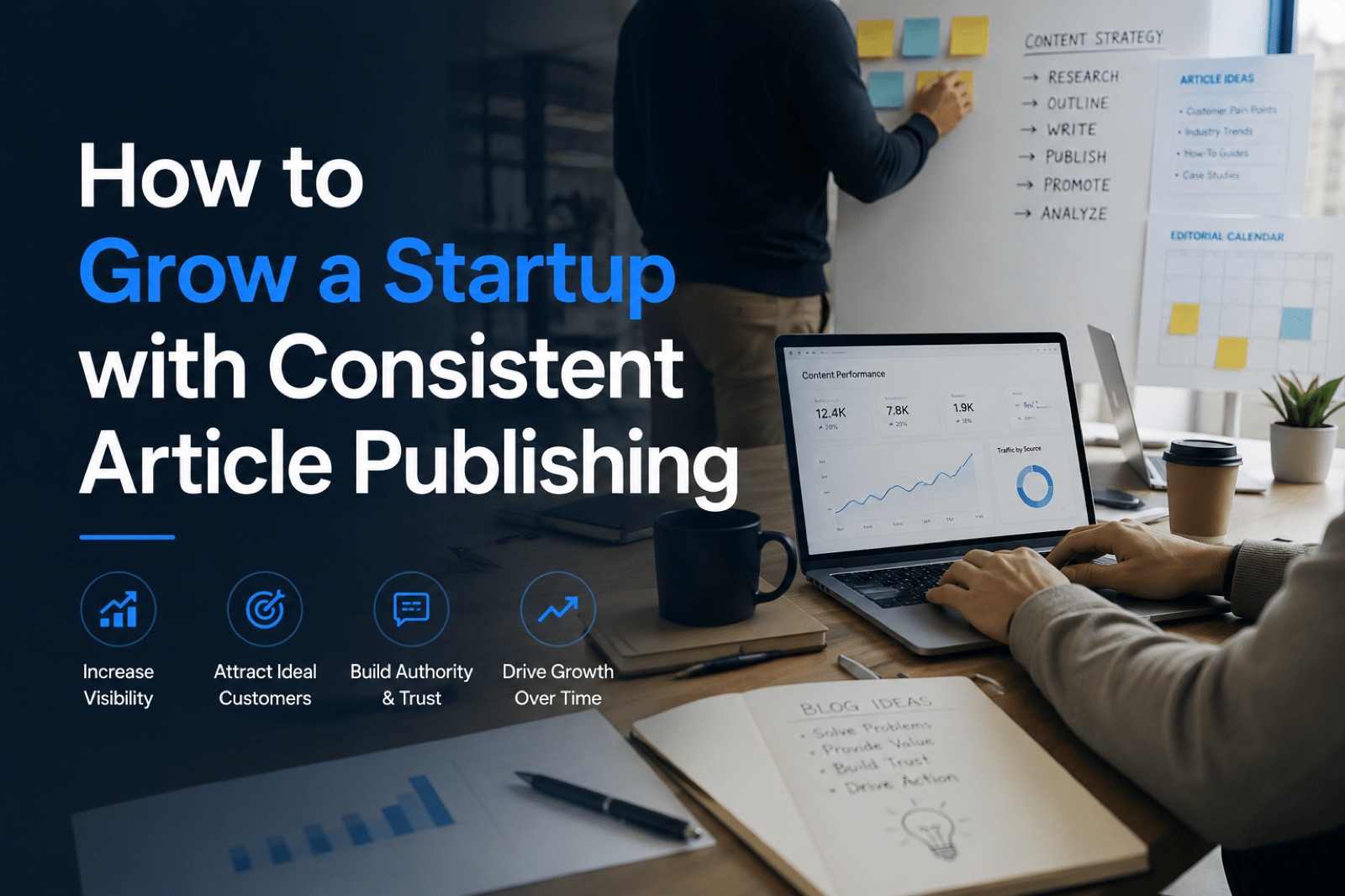
Knowing how to grow a startup through organic search comes down to one habit: publishing useful, SEO-ready articles consistently. Most founders understand this in theory. However, between product decisions, customer calls, and team management, content publishing is often the first thing that gets dropped. The result is a website that rarely earns new search visibility. This article explains why consistent publishing matters, why founders struggle with it, and what a practical solution actually looks like.
How to Grow a Startup with Search Visibility
Growing a startup through organic search means building a library of content that earns impressions, clicks, and trust over time. Search engines like Google reward websites that publish relevant, helpful content on a regular basis. Each new article is an opportunity to appear in front of someone actively searching for what your startup does.
Organic traffic compounds. Therefore, an article published today can continue driving clicks for months or even years without additional spend. This makes content one of the most cost-effective channels available to early-stage founders. In contrast, paid ads stop the moment budget runs out.
- Each article targets a specific search query and search intent
- More articles mean more entry points into your website
- Consistent publishing signals to Google that your site is active and authoritative
- SEO-ready articles build topical depth, which improves overall search ranking
According to Google’s helpful content guidance, sites that demonstrate genuine expertise and publish consistently tend to earn better positions in search results. For founders, this means the content strategy is not optional — it is a growth lever.
Why Founders Know This but Still Don’t Publish
Founders are aware that content matters for startup growth. However, awareness does not automatically translate into action. The challenge is capacity, not knowledge. Running a startup means wearing many hats at once, and writing SEO-ready articles requires time, focus, and a clear system.
Additionally, content planning can feel unclear. Many founders are not sure which topics to target, which search queries to address, or how to structure articles that actually rank. Without a data-led approach, content planning becomes guesswork — and guesswork rarely gets prioritised.
The Most Common Barriers Founders Face
- No dedicated content resource or writer on the team
- Uncertainty about which topics or keywords to target
- Articles started but never finished or published
- Inconsistent publishing schedules that break momentum
- No clear link between content and measurable growth metrics
Furthermore, many founders try to do everything manually — researching keywords, drafting articles, optimising for SEO — without any structured workflow. As a result, content production slows to a near stop. Understanding SEO vs AEO is one step, but acting on that understanding consistently is the harder part.
How to Grow Startup Content Using Real Search Data
How to grow startup content effectively starts with using real search data rather than assumptions. Google Search Console gives website owners a direct view of which queries are generating impressions, which pages are earning clicks, and where there are gaps worth filling. This data is the foundation of smarter content planning.
When founders use actual search query data to decide what to write, they stop guessing what to write next. Instead, they can identify low-hanging SEO opportunities — queries where the site already has some visibility but not yet strong rankings. Writing an article that directly targets one of those queries can lift average position and increase CTR relatively quickly.
Tools like Remway connect directly to Google Search Console data and surface these content opportunities automatically. This removes the research burden from the founder’s plate. For anyone thinking about growing a new website with AI, starting with real search data is the most practical first step.
What Data-Led Content Planning Looks Like
- Pull real search queries from Google Search Console each week
- Identify queries with high impressions but low CTR as priority targets
- Plan articles around search intent, not just keyword volume
- Track average position improvements after publishing each article
The Compounding Effect of Consistent Publishing
Consistent article publishing creates a compounding effect that grows more valuable over time. Each new piece of content adds to the site’s topical authority. Search engines begin to associate the domain with a specific subject area, which improves rankings for both new and existing content. This is one of the most important — and most underestimated — principles behind how to grow a startup organically.
Furthermore, consistent publishing protects against content decay, which is what happens when older articles gradually lose their rankings because fresher content from competitors takes over. Publishing new articles regularly keeps the overall site active and competitive.
| Publishing Frequency | Organic Growth Outcome | Common Founder Challenge |
|---|---|---|
| Rarely (monthly or less) | Slow or flat growth in impressions | Articles deprioritised under other tasks |
| Occasionally (bi-weekly) | Gradual increase in search visibility | Inconsistent momentum and gaps in topics |
| Consistently (weekly) | Compounding organic traffic over time | Requires a clear system and workflow |
| Strategically (data-led weekly) | Faster ranking gains and higher CTR | Needs tools that surface real opportunities |
Research from SEMrush’s content research consistently shows that websites publishing more frequently earn more organic traffic. For founders, the goal is not volume for its own sake — it is consistent, targeted publishing based on real search opportunities.
How to Build an SEO Content Workflow as a Founder
Building a repeatable SEO content workflow is the practical answer to the capacity problem that most founders face. Without a system, content creation depends on motivation — and motivation is unreliable. With a system, publishing becomes a predictable part of the week rather than an occasional project.
A good SEO workflow for a founder does not need to be complicated. It simply needs to answer three questions each week: what to write, how to structure it, and whether it matches search intent. When those answers come from real data, the workflow becomes faster and more confident.
- Set a fixed publishing cadence — even one article per week builds momentum
- Use Google Search Console data to choose topics based on real impressions
- Write articles that match search intent and include the target keyphrase naturally
- Review Google search ranking principles before finalising each article
- Track performance after publishing and adjust the strategy based on what works
According to Moz’s Beginner’s Guide to SEO, consistent content creation is one of the most reliable ways to build domain authority and improve rankings over time. Founders who treat content as a system — not a one-off effort — see far better results.
Why Remway Helps Founders Stay Consistent
Remway is built specifically to help founders and small teams create useful SEO content without the usual bottlenecks. It connects to Google Search Console, surfaces real content opportunities based on actual search data, and helps users plan and write SEO-ready articles that match their brand voice.
For founders who already know how to grow a startup but lack the time to act on that knowledge, Remway removes the planning friction. Instead of spending hours figuring out what to write next, the platform surfaces opportunities directly from impressions, clicks, and average position data. Additionally, it supports a structured content workflow that makes weekly publishing realistic — even for a solo founder or a small team.
If you want to explore how to grow startup organic traffic using a data-led approach, Remway is designed to make that process practical and sustainable. Book a call with the Remway team to see how it fits into your current SEO workflow and where the biggest content opportunities on your website are right now.
Frequently Asked Questions
How often should a startup publish articles to see SEO results?
Publishing at least one SEO-ready article per week is a strong baseline for startup growth. Consistency matters more than volume. A regular publishing schedule helps search engines recognise your site as active and topically relevant. Even one well-structured, data-led article per week builds meaningful organic visibility over time.
How to grow a startup without a large content team?
How to grow a startup with a small team comes down to having a clear system. Use Google Search Console data to identify what to write. Focus each article on a specific search query with real impressions. Tools like Remway remove the research burden, making it possible for one person to plan and publish consistently without guessing what content to create.
Does publishing more articles really improve Google rankings?
Yes, consistent publishing builds topical authority and gives search engines more pages to index and rank. Each article targets a different search query, expanding the website’s overall search visibility. Over time, a larger library of relevant content improves the domain’s authority and lifts rankings for both new and existing pages across the site.
What is content decay and how does it affect startups?
Content decay happens when older articles gradually lose their search rankings as competitors publish fresher, more relevant content. For startups, this means rankings earned in year one can quietly disappear by year two. Regular publishing counteracts decay by keeping the site active. Updating older articles alongside publishing new ones is an effective way to protect existing rankings.
Why is Google Search Console data useful for content planning?
Google Search Console shows which real search queries are generating impressions and clicks for your website. This data removes the guesswork from content planning. Instead of targeting topics based on assumptions, founders can identify queries where their site already has some visibility and write articles designed to improve those positions — a far more efficient approach to startup SEO growth.