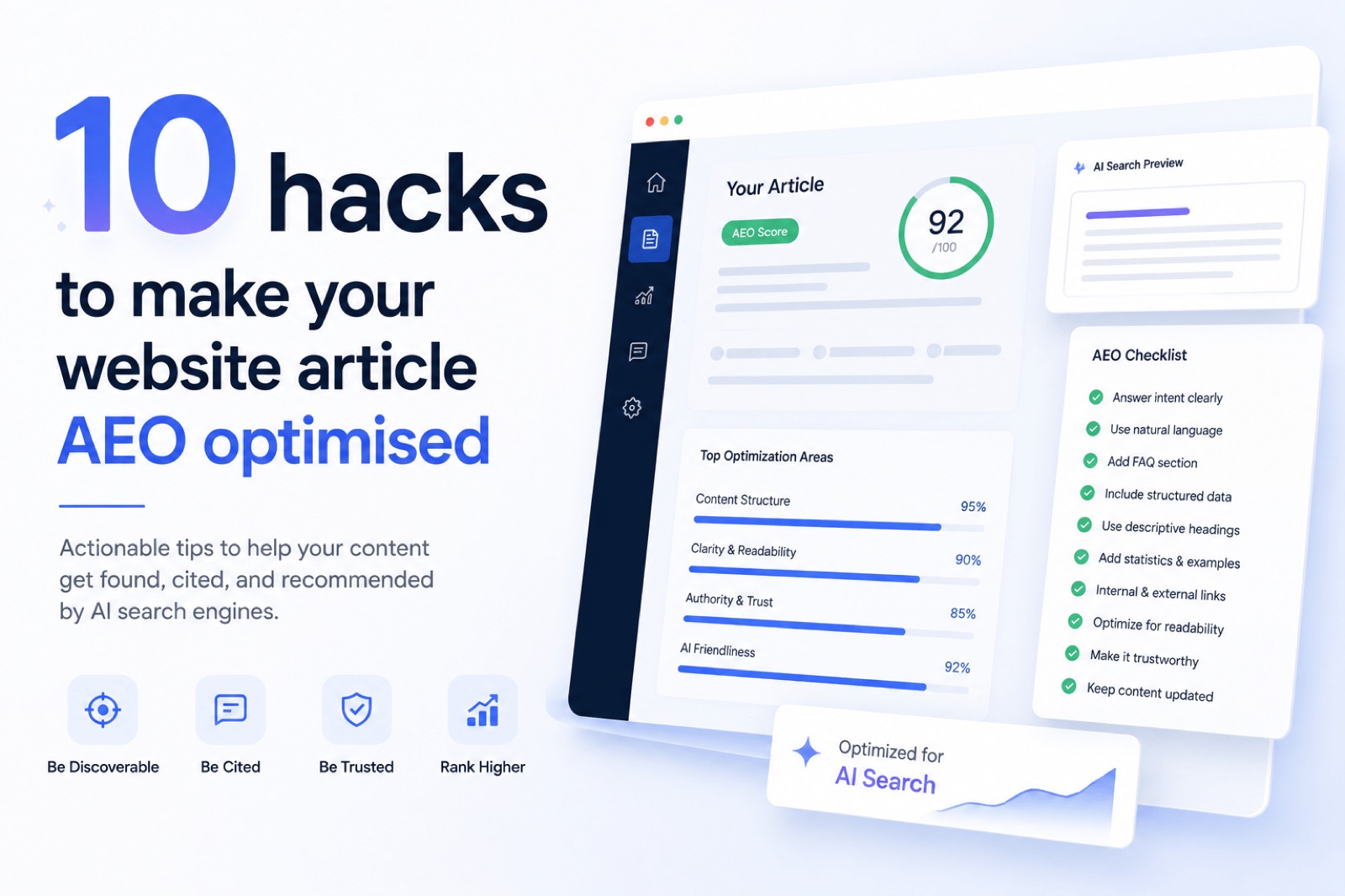
An AEO optimised article is content written specifically to appear as a direct answer in AI-powered search engines like ChatGPT, Perplexity, and Google’s AI Overviews. In 2026, more users are getting answers without clicking through to websites. Therefore, the way you structure and write your content matters more than ever. These 10 practical hacks will help you build every article to meet the demands of answer engine optimisation and grow your search visibility consistently.
What Is an AEO Optimised Article and Why It Matters
An AEO optimised article is a piece of content structured to satisfy answer engines, not just traditional search crawlers. Answer Engine Optimisation (AEO) focuses on making your content extractable, clear, and self-contained so AI systems can surface it as a trusted response. Traditional SEO still matters, but AEO adds a new layer to your content strategy. If your articles are not built for AI extraction, they may be invisible in AI-generated search results even when they rank well on Google.
Furthermore, AI search visibility is growing fast. Tools like Google’s AI Overviews, Perplexity, and Bing Copilot now answer questions directly using content pulled from websites. If your content is not structured to be quoted, it will be skipped. Understanding what is AI search visibility is the first step toward writing content that works across both traditional and AI-driven search.
- AI engines extract individual paragraphs, not full articles
- Content must answer questions directly and completely
- Structure, clarity, and specificity all influence AI selection
- AEO and SEO work together, not against each other
Hack 1: Open Every Section With a Definition
Additionally, every H2 section in your article should open with a direct definition or answer. AI engines often pull the first sentence of a section to use as a response snippet. Therefore, if your opening sentence is vague or uses a pronoun like “this” or “it,” the engine has nothing concrete to extract. Write the subject explicitly in every opening sentence.
For example, instead of writing “This is important because…” write “Internal linking is the practice of connecting pages within the same website to help users and search engines navigate content.” That sentence stands alone. It is factual, specific, and self-contained. Consequently, AI systems can quote it without needing surrounding context.
- State the topic clearly in the first sentence of every section
- Avoid vague openers that rely on the previous paragraph
- Use simple, declarative language that AI can extract cleanly
- Bold the core term or answer within that opening sentence
Hack 2: Write Self-Contained Paragraphs Throughout
Similarly, every paragraph in an AEO optimised article must make sense on its own. AI answer engines often extract single paragraphs to generate responses. If a paragraph starts with “As mentioned above” or “Because of this,” the extracted text becomes meaningless without context. Therefore, treat every paragraph as a standalone unit of information.
This approach also improves readability for human readers. Short, focused paragraphs are easier to scan. Moreover, they reduce cognitive load, which keeps readers on your page longer. Each paragraph should cover one point, state its subject clearly, and close with a useful takeaway. That structure helps both readers and AI systems process your content efficiently.
- Never start a paragraph with “this,” “it,” or “these” as a reference
- Repeat the subject noun rather than using pronouns across paragraphs
- Limit each paragraph to one core idea
- Close each paragraph with a clear, actionable point
Hack 3: Use an AEO Optimised Article Structure With Headers
An AEO optimised article relies heavily on a clean, logical header structure. AI engines use H2 and H3 tags to understand the topics your content covers. Headers act as signposts that help AI systems match your content to specific search queries. Therefore, your headers should include your focus keyphrase or a close synonym where natural.
How to Format Headers for AEO
Headers should be phrased as questions or clear topic statements. For example, “How to Improve CTR in Google Search Console” is more AEO-friendly than “More Tips.” Furthermore, using question-based H2s and H3s aligns your content directly with the natural language queries that users type into AI search tools. Consequently, your content is more likely to be matched and surfaced as a direct answer.
- Use exact or near-exact keyphrases in at least two H2 tags
- Phrase some headers as questions to match voice and AI queries
- Use H3s to break down complex sections into digestible sub-points
- Avoid clever or vague header phrasing that lacks keyword clarity
Hack 4: Add a Focused FAQ Section
Furthermore, a FAQ section is one of the most effective ways to make an AEO optimised article perform in AI search. AI engines frequently pull FAQ answers verbatim as featured snippets or direct responses. Therefore, each FAQ answer must be fully self-contained, between 60 and 80 words, and answer the question without referencing other sections. Do not write “as discussed above” inside a FAQ answer.
Place your FAQ section near the end of your article. Use H3 tags for each question and a paragraph tag for each answer. This formatting signals to AI engines that these are distinct question-and-answer pairs. Moreover, good FAQ sections also support traditional SEO by capturing long-tail search queries that your main content may not target directly.
- Write every FAQ answer as a standalone response
- Keep answers between 60 and 80 words for optimal extraction
- Use H3 for questions and p tags for answers
- Target real questions your audience asks in search
Hack 5: Bold Your Key Answers and Core Terms
An AEO optimised article uses bold text strategically to highlight extractable answers. When AI systems scan your content, bold text acts as a visual and structural cue. It signals that a phrase or sentence contains the direct answer to a question. Therefore, bold the core term or the key finding in the first sentence of each major section.
However, avoid overusing bold formatting. If everything is bold, nothing stands out. Use bold for definitions, direct answers, and critical statistics or facts. Additionally, bold text improves scannability for human readers, which reduces bounce rates and increases time on page. Both of those signals contribute positively to your overall Google search ranking performance.
- Bold the core term in each section’s opening sentence
- Use bold for direct answers, not decorative emphasis
- Limit bold usage to the most critical phrases per section
- Avoid bolding full sentences, focus on the key phrase or answer
Hack 6: Include a Comparison Table
Moreover, including a comparison table in an AEO optimised article improves AI extractability significantly. Tables help AI engines understand structured relationships between concepts. They also satisfy user intent for comparison queries, which are common in AI-driven searches. Below is a comparison of traditional SEO content versus AEO optimised content across key dimensions.
| Dimension | Traditional SEO Content | AEO Optimised Article |
|---|---|---|
| Paragraph structure | Flowing narrative, context-dependent | Self-contained, standalone paragraphs |
| Header style | Creative or topic-based | Question-based or definition-led |
| FAQ section | Optional, often generic | Required, self-contained answers |
| Bold usage | For emphasis | For direct answers and core terms |
| Target output | Google blue-link rankings | AI snippets, direct answers, citations |
| Audience | Search crawlers and readers | AI engines, readers, and voice search |
Hack 7: Avoid Passive Voice and Keep Sentences Short
An AEO optimised article uses active voice throughout. Passive sentences are harder for AI engines to extract cleanly because the subject-verb relationship is less direct. For example, “The report was written by the team” is weaker than “The team wrote the report.” Active voice makes your sentences crisper, faster to read, and easier to quote. Therefore, review every sentence and convert passive constructions to active ones.
Additionally, keep every sentence under 20 words. Short sentences process faster for both AI and human readers. They also reduce the chance of misinterpretation by AI systems looking for direct answers. Transition words like “therefore,” “additionally,” and “consequently” help connect ideas without creating long, tangled sentences. As a result, your content flows clearly while staying AEO-friendly throughout.
- Use subject-verb-object sentence structure consistently
- Keep sentences under 20 words wherever possible
- Avoid passive constructions especially in opening sentences
- Use transition words to connect ideas without lengthening sentences
Hack 8: Match Search Intent Precisely
Furthermore, matching search intent is essential to writing an effective AEO optimised article. AI engines do not just match keywords. They assess whether the overall content satisfies the user’s underlying goal. Therefore, before writing, identify whether the query is informational, navigational, or transactional. Then structure your entire article to serve that specific intent from the first sentence onward.
Using real search data is the most reliable way to understand intent accurately. Google Search Console data shows you the exact queries people use to find your content, along with impressions, clicks, and average position. Consequently, you can write content that answers the actual questions your audience is already asking rather than guessing at what they want. For practical guidance on AI search visibility best practices, this is a strong starting point.
- Identify query intent before drafting your article structure
- Use real search queries from Google Search Console as your guide
- Align your title, intro, headers, and FAQ with the same intent
- Avoid mixing multiple intents in a single article
Hack 9: Keep Content Fresh and Monitor for Decay
In addition, an AEO optimised article needs to stay current. AI engines favour content that is accurate and up to date. If your article contains outdated statistics, deprecated tools, or irrelevant examples, AI systems are less likely to cite it. Therefore, schedule regular content reviews and update key facts, examples, and references at least once per year.
Content decay happens when a page gradually loses rankings and impressions over time without obvious changes. It often occurs because competitors publish fresher content or search intent shifts. Monitoring your search data regularly helps you spot decay early. In fact, addressing content decay before it erodes your rankings is one of the highest-impact SEO maintenance tasks you can do.
- Review and update articles at least once per year
- Replace outdated statistics with current or qualitative alternatives
- Monitor impressions and clicks in Google Search Console for decay signals
- Refresh examples and tool references to keep content relevant
Hack 10: Use Internal and External Links Strategically
Finally, linking is a critical but often overlooked element of an AEO optimised article. Internal links help AI engines and search crawlers understand how your content connects to the broader topic cluster on your website. External links to credible sources signal that your content is grounded in real, verifiable information. Therefore, include both types of links in every major article you publish.
For external links, choose authoritative sources that are relevant to the specific claim or topic you are linking from. For example, linking to Google Search Console when discussing search data adds credibility and context. For internal links, connect to related articles that deepen the reader’s understanding of the topic. Additionally, well-placed internal links improve crawl depth and reduce bounce rates across your entire site.
- Add at least one outbound link to a credible external source
- Use descriptive anchor text that includes relevant keyphrases
- Link internally to related content within your topic cluster
- Avoid linking to unrelated pages just to increase link count
Frequently Asked Questions
What makes an article AEO optimised?
An AEO optimised article is structured so AI engines can extract and quote its content directly. Key characteristics include self-contained paragraphs, definition-style section openers, a focused FAQ section, bold key answers, clean header structure, and active voice throughout. The goal is to make every section independently understandable so AI systems can surface it as a direct answer without needing surrounding context from the article.
How is AEO different from traditional SEO?
Traditional SEO focuses on ranking in Google’s blue-link results by optimising for crawlers, keywords, and backlinks. AEO optimised article content goes further by structuring information for AI engines like ChatGPT, Perplexity, and Google AI Overviews. AEO prioritises direct answer extraction, self-contained paragraphs, and question-based headers. Both approaches work together, but AEO adds an additional layer of structure that traditional SEO alone does not require.
How many times should a keyphrase appear in an AEO article?
An AEO optimised article should include the exact keyphrase at least seven times throughout the content. Placement matters as much as frequency. Include the keyphrase in the first sentence of the introduction, in at least two H2 headers, in the opening sentence of key sections, inside a bullet point, and within a FAQ answer. This distribution ensures both AI engines and traditional search crawlers recognise the article’s core topic clearly.
Should every paragraph in an AEO article be self-contained?
Yes. Every paragraph in an AEO optimised article should make complete sense on its own. AI engines extract individual paragraphs to generate responses, so any paragraph that references a previous section will lose its meaning when quoted in isolation. Start each paragraph by naming the subject explicitly. Avoid opening with pronouns like “this,” “it,” or “these” that refer back to previous content. This approach also improves readability for human readers significantly.
How do I know if my article is performing in AI search?
Monitoring AI search performance requires tracking whether your content appears in AI Overviews, Perplexity citations, or other AI-generated responses. Start by reviewing your Google Search Console data for impressions, clicks, and average position. Falling impressions on previously strong pages can indicate that AI answers are replacing clicks. Tools that specialise in AI search visibility can help you track and respond to these changes more precisely and consistently.