
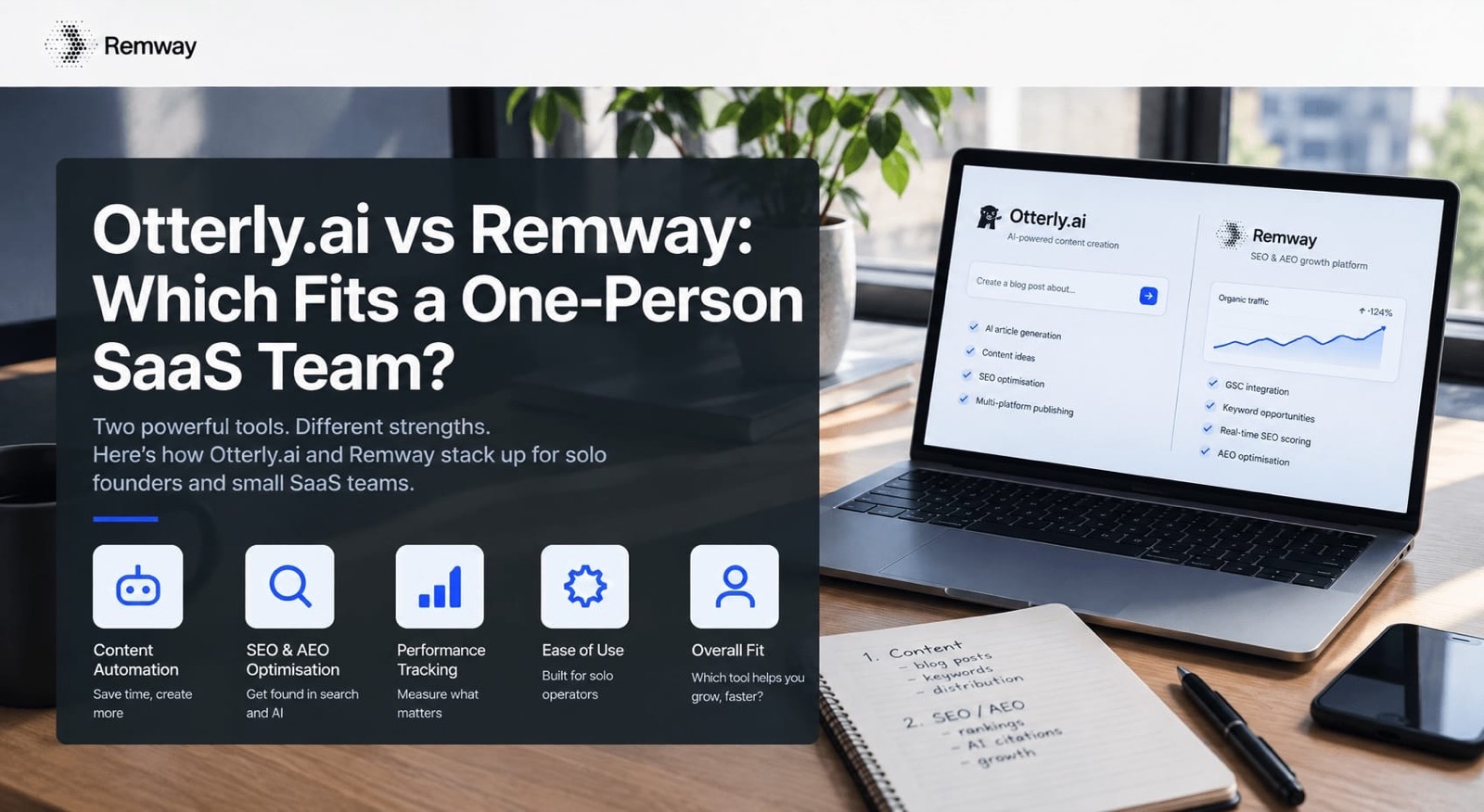
Otterly vs Remway is a comparison worth making carefully, because the two tools sit in different categories. Otterly.ai is a well-built, self-serve AI visibility tracker. Remway combines visibility tracking with content generation in a single workflow. For a solo founder or one-person SaaS team, that structural difference matters more than any feature list. This article sets out what each tool actually does, what each costs in rough terms, and which one suits which kind of team.
What Otterly vs Remway Means for AI Visibility Tracking
Otterly.ai is a dedicated AI visibility tracker that monitors how often your brand appears in responses from AI engines like ChatGPT, Perplexity, Google AI Overviews, and Microsoft Copilot. It is genuinely well-suited to teams that want fast, self-serve setup without a lengthy onboarding process. You can start tracking in minutes, and the free trial is real — not a demo request form.
Otterly’s base tiers cover four engines by default. Additional engines, including Gemini, Google AI Mode, and Claude, are available as paid add-ons on top of the base subscription. Furthermore, the prompt-tracking system is clear: you buy a plan that covers a set number of tracked prompts per month. As a result, smaller teams can start at a low cost and scale the engine coverage they need.
For context on how the AI visibility landscape is shifting, the Generative AI Performance Report Update for August 2026 covers recent changes in how major engines surface brand mentions — useful background when evaluating any tracking tool.
Otterly is, in short, a well-priced, focused product. The otterly ai review consensus among solo founders is that it does what it promises: it measures your position in AI search results clearly and reliably.
Otterly Pricing: What You Should Know Before You Commit
Otterly pricing starts at roughly $29 per month on its entry tier, which covers a limited prompt count and four AI engines by default. However, adding Gemini, Google AI Mode, or Claude each carries an additional cost on top of that base price. Therefore, the real monthly spend depends on which engines matter to your audience.
That said, every pricing figure in this article should be treated as a guide only. Otterly’s tier structure and add-on costs change regularly. Always verify current pricing directly on Otterly’s own pricing page before making a decision. Committing to a number here without same-day verification would not be fair to you or to Otterly.
For teams evaluating otterly pricing against other options, the honest summary is this: Otterly’s entry cost is low relative to enterprise AI monitoring tools. Additionally, because it is self-serve, there are no sales calls or minimum contract lengths to navigate. That makes it one of the more accessible otterly alternative comparisons in the market right now.
- Entry tier: approximately $29/month, subject to change — verify before subscribing
- Four engines included by default on base tiers
- Gemini, Google AI Mode, and Claude available as paid add-ons
- Real free trial available without a sales call
- Prompt limits scale with plan tier, not engine count alone
The Core Gap: Otterly Measures, It Doesn’t Create
Otterly is a measurement tool, and that is not a criticism — measurement is genuinely valuable. However, for a solo founder without a separate content workflow, measurement alone creates a problem. Otterly tells you where you stand in AI search results. It does not help you produce the content that changes where you stand.
That structural gap matters most when you have no content budget and no content person. Knowing that your brand appears in 12% of tracked ChatGPT responses is useful data. But acting on that data requires writing, publishing, and optimising content — none of which happens inside Otterly. Consequently, you end up managing two separate tools, two separate workflows, and two separate costs.
For solo SaaS founders, this is not always obvious at the point of sign-up. The otterly ai review experience is typically positive — the tool is clear, the data is clean. The friction appears later, when you realise the content work still has to happen somewhere else. Understanding what AI search visibility actually requires in practice — including content production — helps clarify why tracking alone is only half the job.
Why Solo Teams Feel This More Than Larger Teams
A five-person SaaS team likely has a content person or an agency already. For them, adding Otterly as a tracking layer on top of an existing content workflow makes complete sense. In contrast, a one-person team typically cannot absorb two separate tools without one of them going unused. The tracking tool tends to win in the short term because it is immediate and visual. The content work tends to slip because it takes longer and has no built-in deadline.
Otterly vs Remway: Where a Combined Tool Fits Differently
Remway combines AI visibility tracking with content generation in a single workflow, which makes it structurally different from Otterly rather than simply a competing tracker. For a solo founder who needs both visibility data and the content that improves that data, having both in one place removes the friction of switching between tools.
Otterly vs Remway is therefore less a question of which tracks better, and more a question of what you actually need to do next. Remway is designed for teams where the person checking the visibility data is the same person writing and publishing the content. That is the specific workflow it supports. If you want to understand how consistent article publishing connects to startup growth, the guide on how to grow a startup with consistent article publishing is a practical companion to this comparison.
- Otterly vs Remway on tracking depth: Otterly currently has broader engine coverage and more mature tracking infrastructure
- Otterly vs Remway on content: Remway generates human-reviewed, credentialed content; Otterly does not include content creation
- Otterly vs Remway on workflow: Remway keeps measurement and production in one place; Otterly pairs with a separate content tool
- Otterly vs Remway on price: Otterly’s entry price is lower if you only need tracking
Honest Trade-Offs: What Remway Does Not Yet Do
Remway is a newer and smaller product than Otterly, and it is important to state that plainly. Otterly has more mature tracking infrastructure, broader AI engine coverage, and a more established track record in the market. Solo founders evaluating this comparison deserve an honest picture, not a one-sided one.
Remway does not yet match Otterly’s depth on pure visibility tracking. Additionally, if you already have a reliable content workflow — an agency, a freelancer, or a consistent internal process — then the content generation side of Remway is something you are already covering elsewhere. In that case, Otterly is the more logical choice, and you should not pay for content tooling you do not need.
For teams interested in how AI visibility and content production fit together across different tools, the BrightEdge alternative comparison for small teams covers similar trade-offs in more depth. Similarly, the Profound alternative roundup gives a broader view of AI visibility tools available to smaller teams in 2026.
| Feature | Otterly.ai | Remway |
|---|---|---|
| AI visibility tracking | Yes — 4 engines base, add-ons available | Yes — included, fewer engines currently |
| Content generation | No | Yes — human-reviewed, credentialed |
| Free trial | Yes — self-serve | Yes |
| Entry price (approx.) | ~$29/month (verify on Otterly’s site) | Varies — check remway.app |
| Best for | Teams with existing content workflow | Solo founders needing tracking + content |
| Engine add-ons | Gemini, Claude, Google AI Mode (paid) | Expanding — check current coverage |
Who Should Actually Pick Which Tool
The right choice between otterly vs remway depends entirely on what your content situation looks like today, not on which tool has the longer feature list. Both tools are legitimate options for solo SaaS founders. The distinction is structural, not qualitative.
Choose Otterly if you already have a content workflow in place — whether that is an agency, a freelancer, or a consistent internal publishing habit. In that case, Otterly gives you clean AI visibility and content data to feed into a process that already exists. You do not need a combined tool. You need good measurement, and Otterly delivers that.
Choose Remway if you are a solo founder or one-person team who needs both tracking and content production but cannot manage two separate subscriptions or two separate workflows. Remway is specifically useful when the person reading the AI visibility data is also the person who has to act on it by writing and publishing. Organic traffic from AI search engines improves when you publish consistently against real search queries — Remway is built around that loop.
Above all, be honest about where the bottleneck actually is. If you have tracking data but are not publishing content, more tracking data will not solve the problem. Conversely, if you are publishing content but have no idea whether it is improving your AI search visibility and impressions, you are working without a feedback loop.
Frequently Asked Questions
How much does Otterly.ai cost?
Otterly pricing starts at approximately $29 per month on its entry tier, covering a limited prompt count and four AI engines by default. Additional engines such as Gemini, Google AI Mode, and Claude are available as paid add-ons. However, pricing tiers and add-on costs change regularly, so always verify the current figures directly on Otterly’s pricing page before committing.
Does Otterly.ai help create content, or only track visibility?
Otterly.ai is a measurement-only tool. It tracks how often your brand appears in AI engine responses and gives you clear visibility data. It does not generate, suggest, or publish content. If you want to act on the tracking data by creating content, that work has to happen in a separate tool or through a separate process outside of Otterly.
What AI engines does Otterly track by default?
Otterly’s base tiers cover four AI engines by default: ChatGPT, Perplexity, Google AI Overviews, and Microsoft Copilot. Gemini, Google AI Mode, and Claude are available as separate paid add-ons on top of the base subscription price. The exact engine lineup and add-on structure should be confirmed on Otterly’s own site, as coverage expands over time.
Is there a tool that combines AI visibility tracking with content creation?
Remway combines AI visibility tracking with human-reviewed content generation in a single workflow. This makes it different from tracking-only tools like Otterly. Remway is designed specifically for solo founders and small teams who need both measurement and content production but cannot manage two separate subscriptions. It is a newer product with less tracking depth than Otterly, but covers both functions in one place.
When does it make sense to use Otterly instead of Remway?
Otterly is the better fit if you already have a reliable content workflow through an agency, freelancer, or internal process. In that case, you only need clean tracking data layered on top of existing production — and Otterly does that well at a low entry price. Remway is more useful when the same person handles both tracking and content, with no separate content resource available.