
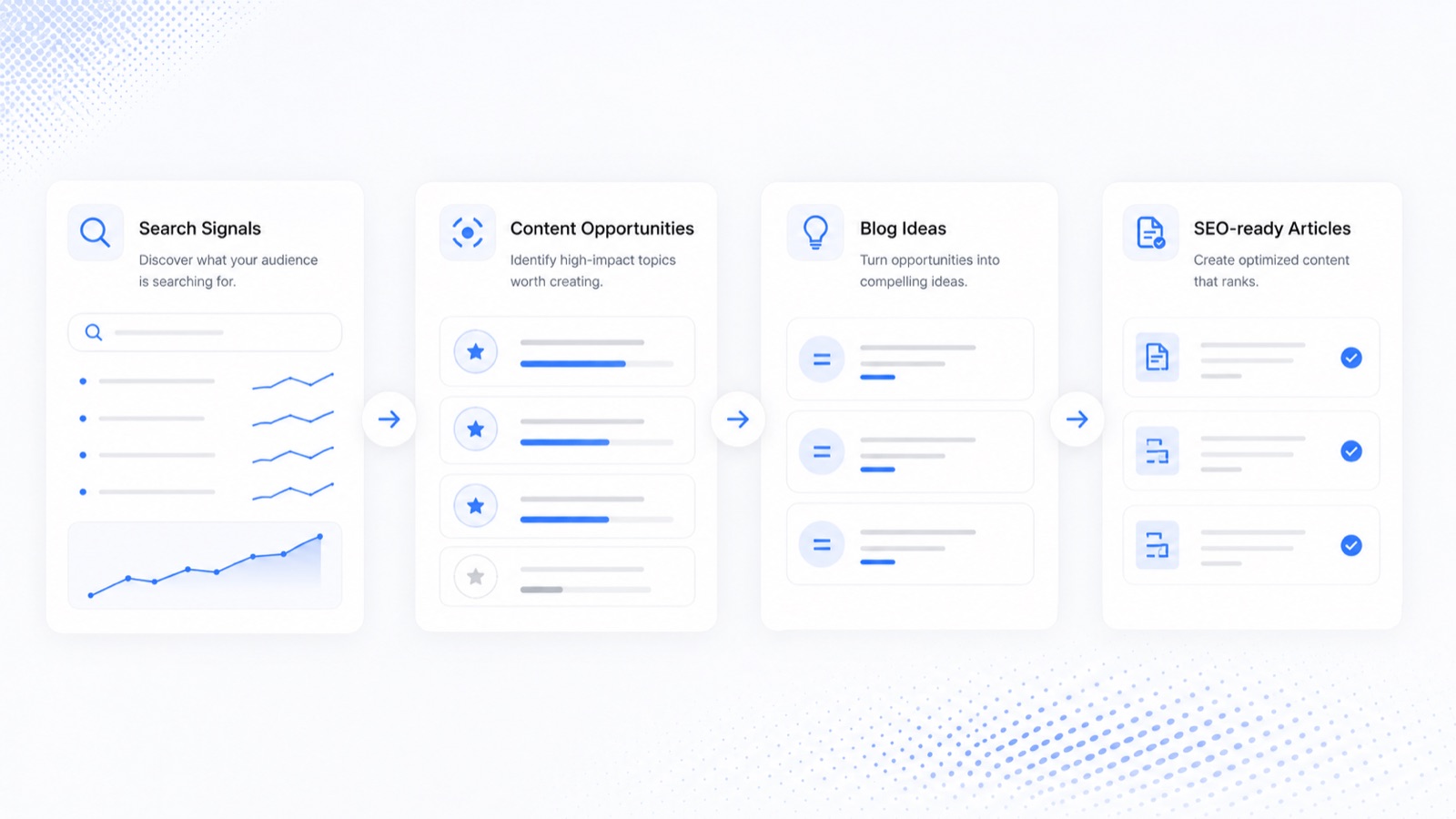
SEO content opportunities are topics, keywords, search queries, or existing pages that could bring more organic traffic if you create, update, or optimise content around them. They come from real search data, not guesswork. Therefore, finding them means looking at what people are already searching for, which pages are close to ranking well, and where your site has gaps that competitors are filling. This guide explains what SEO content opportunities are, why they matter, and how you can find and use them to grow your search visibility.
Quick Answer: What Are SEO Content Opportunities?
SEO content opportunities are topics, keywords, search queries, or existing pages that have the potential to bring more organic traffic if you create, update, or optimise content around them. They can come from Google Search Console data, keyword research, competitor gaps, customer questions, or pages that are already ranking but not getting enough clicks.
What Is an SEO Content Opportunity?
An SEO content opportunity is any signal that tells you a topic is worth writing about or improving. First, it could be a search query your site is already appearing for but not ranking strongly. Additionally, it could be a question your customers ask that you have never answered on your website. Furthermore, it could be an article that ranks on page two and just needs more depth to move higher.
The key idea is that SEO content opportunities are rooted in real search demand. In contrast to writing random blog posts, a data-led approach means every article you create has a reason to exist. That reason comes from impressions, clicks, average position, CTR, and the actual queries people type into Google. Consequently, your content planning becomes sharper and your organic traffic grows more consistently.
Similarly, SEO content opportunities are not limited to new articles. They also include updating outdated pages, combining thin articles into one strong guide, or improving a page that ranks on position nine for a valuable keyword.
Why SEO Content Opportunities Matter for Website Growth
Finding SEO content opportunities matters because it stops you from wasting time on content nobody searches for. As a result, every piece of content you publish has a better chance of bringing in organic traffic. Furthermore, a focused content strategy builds topical authority, which helps Google understand what your website is about.
Businesses that plan better articles based on real search queries tend to rank faster and more consistently. For example, a small business that answers the specific questions its customers ask will often outrank larger competitors who publish generic content. Above all, content created around genuine demand is more useful, more relevant, and more likely to convert visitors into customers.
Moreover, SEO content opportunities help you allocate your time and resources more efficiently. Instead of publishing twenty average articles, you can publish ten strong, well-researched guides that each serve a clear search intent. That approach produces better long-term website growth.
Common Types of SEO Content Opportunities
Additionally, it helps to understand the different forms that SEO content opportunities can take. The table below shows the most common types and the best action for each one.
| Type of Opportunity | What It Means | Best Action |
|---|---|---|
| High impressions, low clicks | Your page appears in search but people do not click it | Improve the title tag and meta description |
| Page two keywords | Keywords ranking between positions 8 and 20 | Improve and expand the existing article |
| Customer questions | Frequent questions your audience asks that you have not answered | Create a dedicated FAQ or guide article |
| Competitor content gaps | Topics competitors rank for that you do not cover | Create a stronger, more detailed article |
| Outdated existing content | Pages that ranked well but are now out of date | Update facts, add new sections, re-publish |
| Product-related educational topics | Searches that relate directly to what you sell or offer | Write educational content that supports your product |
| Low-competition long-tail keywords | Specific queries with lower competition and clear intent | Create focused articles that answer these queries directly |
How to Find SEO Content Opportunities Using Search Data
Finding SEO content opportunities starts with reviewing the data you already have. Google Search Console is the most direct source of real search queries that show how your site performs in search results. Therefore, start there before investing time in any paid keyword research tool.
Step 1: Review Your Google Search Console Queries
Open the Performance report in Google Search Console and look at the full list of queries your site ranks for. Filter by impressions to find queries that appear frequently but receive few clicks. These are strong SEO content opportunities because Google already considers your site relevant for those searches.
Step 2: Find Keywords Ranking Between Positions 8 and 20
Pages ranking in positions 8 to 20 are close to the top results but not quite there. Consequently, improving these pages can produce faster ranking gains than creating entirely new content. Look for pages with decent impressions and an average position between 8 and 20, then expand and improve those articles.
Step 3: Collect Customer Questions
Furthermore, think about the questions your customers ask your sales team, support team, or chatbot. These real questions reflect genuine search intent. If customers are asking you directly, others are likely searching for the same answers on Google. Each question is a potential SEO content opportunity worth creating an article for.
Step 4: Group Related Topics Into Content Clusters
Instead of writing a separate thin article for every keyword variation, group related queries into one strong guide. For example, if you see queries like “SEO article ideas”, “how to find blog topics for SEO”, and “content gaps in Google Search Console”, you can combine these into one comprehensive article. This approach avoids keyword cannibalisation and creates more useful, complete content.
For a deeper walkthrough, read our guide on how to find content opportunities in Google Search Console.
How to Prioritise SEO Content Opportunities
SEO content opportunities are only useful if you act on the right ones first. Therefore, use a clear prioritisation framework to decide where to focus your content planning effort.
| Criteria | Question to Ask | Why It Matters |
|---|---|---|
| Business relevance | Does this topic relate to what we do or sell? | Irrelevant traffic does not convert or build authority |
| Search demand | Are people actually searching for this? | No demand means no organic traffic potential |
| Ranking potential | Can we realistically rank for this keyword? | Targeting unwinnable keywords wastes time |
| Search intent | Does our content match what the searcher wants? | Mismatched intent means high bounce rates |
| Conversion potential | Could this article lead to a sign-up, enquiry, or purchase? | High-value traffic supports business growth |
| Content quality potential | Can we create something genuinely better than what ranks now? | Google rewards helpful, high-quality content |
Example: Turning an SEO Content Opportunity Into an Article
SEO content opportunities become most valuable when you act on them with focus and intention. Here is a practical example that shows the process clearly.
A website notices three separate queries appearing in its Google Search Console data: “Google Search Console blog ideas”, “how to find SEO article ideas”, and “content opportunities in Google Search Console”. First, the team might consider writing three separate short articles. However, that approach creates thin content and splits ranking power across multiple pages.
Instead, the smarter approach is to create one comprehensive guide that answers all three queries under a single topic. Consequently, the article becomes stronger, more useful, and better positioned to rank. It covers the full search intent rather than only part of it. As a result, the page earns more impressions, more clicks, and more organic traffic over time.
This is a clear example of how identifying SEO content opportunities correctly leads to better content decisions, not just more content. Moreover, this approach supports long-term topical authority, which helps the entire website grow in search visibility.
How Remway Helps With SEO Content Opportunities
Remway helps make this process easier by using real Google Search Console data to find SEO content opportunities and turn them into SEO-ready article drafts. Furthermore, Remway connects directly to your search data, surfaces the queries and pages with the most potential, and helps you create articles that match your brand voice and support your content strategy.
Instead of manually sorting through hundreds of queries in Google Search Console, Remway identifies the clearest content opportunities and organises them into actionable article ideas. This is particularly useful for founders, small teams, and agencies that want a smarter content planning process without hiring a full SEO team. Additionally, it ensures that every article you publish is grounded in real search data rather than assumptions.
Common Mistakes to Avoid With SEO Content Opportunities
Finally, understanding SEO content opportunities also means knowing what not to do. Many websites make avoidable mistakes that limit their organic traffic growth despite producing a lot of content.
- Chasing only high-volume keywords: High-volume keywords are often highly competitive. Therefore, long-tail SEO content opportunities frequently offer faster, more achievable results.
- Writing content with no business relevance: Traffic that does not relate to your product or service rarely converts. Focus on topics that connect to what you actually offer.
- Creating one article for every tiny keyword variation: This creates thin content and cannibalisation. Instead, group related queries into one strong guide.
- Ignoring search intent: If your article does not match what the searcher wants, it will not rank well regardless of how well-written it is.
- Forgetting to update existing pages: Outdated articles lose rankings over time. Consequently, updating existing content is often faster than creating something new.
- Publishing AI drafts without human review: AI-generated content needs human editing to match your brand voice, add accuracy, and meet Google’s helpful content guidance.
- Not tracking results after publishing: Without tracking, you cannot tell which SEO content opportunities are performing and which need further improvement.
For a broader foundation, the Google SEO Starter Guide explains the core principles that make content rank well in search results.
Frequently Asked Questions
What are SEO content opportunities?
SEO content opportunities are topics, keywords, search queries, or existing pages that could bring more organic traffic if you create, update, or optimise content around them. They come from real search data sources such as Google Search Console, keyword research tools, customer questions, and competitor analysis. Above all, they are based on actual demand rather than assumptions about what people want to read.
How do you find SEO content opportunities?
You can find SEO content opportunities by reviewing your Google Search Console queries, looking for pages with high impressions but low clicks, identifying keywords ranking between positions 8 and 20, collecting customer questions, and analysing competitor content. Additionally, grouping related queries together helps you find stronger article ideas rather than targeting individual keywords in isolation.
Are SEO content opportunities the same as keywords?
Not exactly. A keyword is a specific search term, whereas SEO content opportunities are broader signals that include keywords, search queries, content gaps, underperforming pages, and customer questions. Therefore, an SEO content opportunity might include several related keywords grouped around a single topic. Furthermore, it considers search intent and business relevance, not just search volume.
Should I create a new article or update an existing page?
It depends on what Google Search Console data shows. If a page already ranks between positions 8 and 20, updating it is often faster than creating a new article. However, if no relevant content exists on your site for a topic with clear search demand, creating a new article is the right move. In fact, improving existing pages is one of the most underused SEO content opportunities available.
How do I prioritise SEO content ideas?
Prioritise SEO content opportunities based on business relevance, search demand, ranking potential, search intent, and conversion value. Consequently, focus first on topics that relate directly to your product or service and have realistic ranking potential. Additionally, consider how quickly you can create quality content for that topic. Above all, avoid chasing high-volume keywords that are unlikely to rank or convert.
Can Remway help find SEO content opportunities?
Yes. Remway connects to your Google Search Console data and surfaces the clearest SEO content opportunities from your real impressions, clicks, and ranking data. It then helps you turn those opportunities into SEO-ready articles that match your brand voice. Therefore, Remway is useful for founders, marketers, small business owners, and agencies who want a smarter, data-led content planning process without spending hours in spreadsheets.