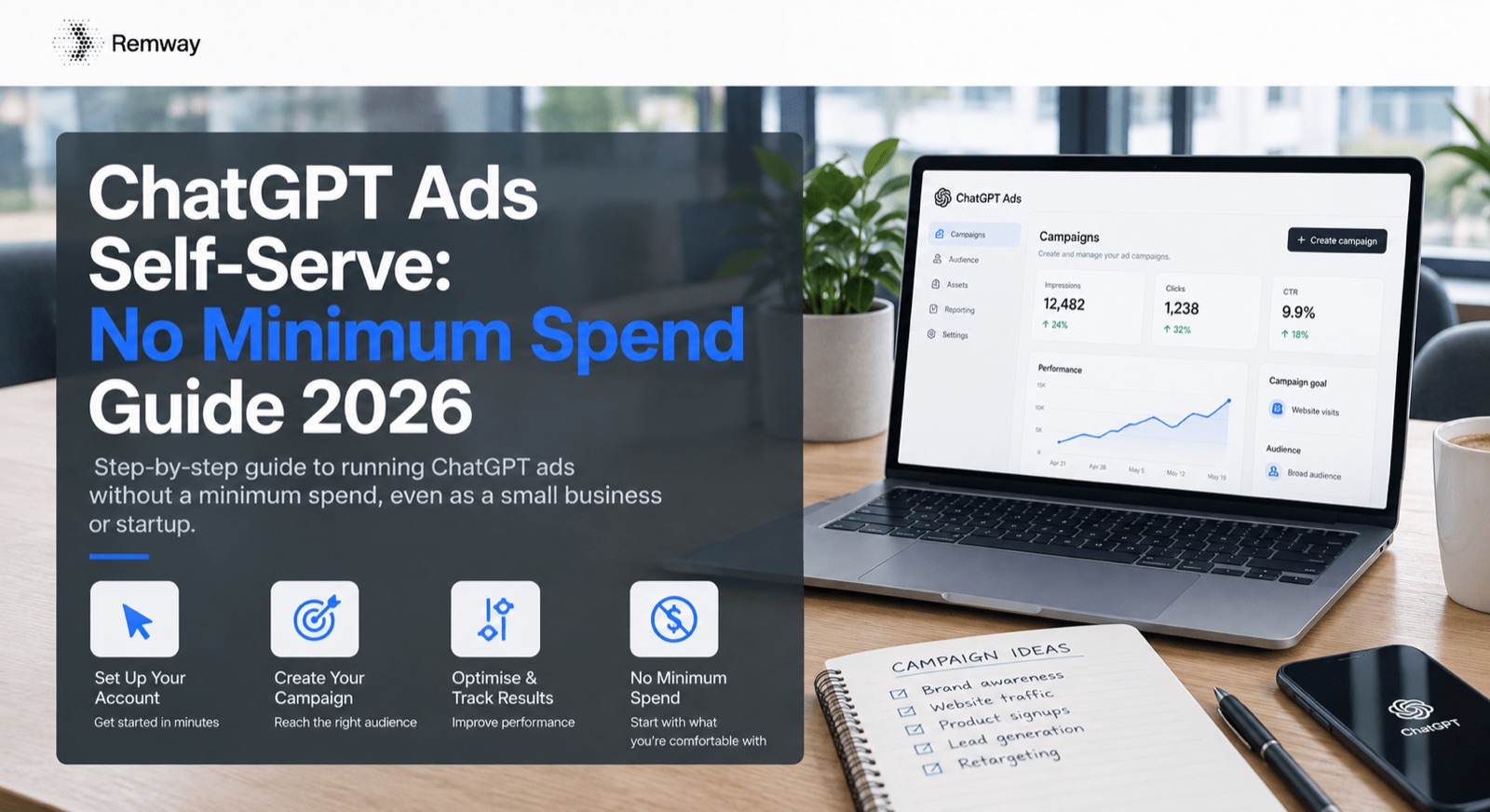
ChatGPT ads self-serve is now accessible to small teams and solo founders, without the enterprise-level minimums that made early ChatGPT advertising out of reach. If you assumed this channel was reserved for companies with large media budgets, that assumption is now outdated. The self-serve Ads Manager from OpenAI removes the spend floor entirely, meaning a founder with a few hundred pounds to test can access the same platform that enterprise teams use. If you’re completely new to how this channel works, start with this overview of ChatGPT ads for founders before continuing here.
What Changed: From Enterprise Pilot to ChatGPT Ads Self-Serve
ChatGPT advertising began as a closed, high-minimum enterprise pilot, meaning smaller teams had no realistic path to access it. OpenAI has since opened a self-serve Ads Manager that removes the minimum spend requirement entirely. Reported launch timelines vary across sources, so treat any specific date you find elsewhere with caution — what matters is that, as of publishing in 2026, self-serve access is live. This is, therefore, the first point at which ChatGPT ads self-serve is genuinely viable for a founder testing with a limited budget, rather than an enterprise brand with a dedicated media team.
Additionally, the shift mirrors what Google and Meta did when they opened their platforms to self-serve advertisers. However, ChatGPT advertising is still early-stage. That means fewer benchmarks, less published data, and more uncertainty — but also less competition for early movers willing to run careful tests.
Who Can Access the ChatGPT Ads Self-Serve Platform
Access to the ChatGPT ads self-serve manager is currently available in a limited set of markets, and availability continues to expand. Most published guides focus on US access, which creates a real gap for UK-based founders. The good news is that UK businesses are among the supported markets, so you do not need to route through a US entity or work with a reseller to get started. However, you should verify current availability directly via OpenAI’s official site at the time you sign up, since supported regions can change as the platform scales.
To access the Ads Manager, you will need an OpenAI account and to apply or navigate to the advertising section of the platform. Approval is not instantaneous in all cases, so building in lead time before your intended campaign launch is sensible. Furthermore, account eligibility requirements, billing currency options, and supported ad formats may differ slightly by region — confirming these details before planning your budget avoids surprises.
What ChatGPT Ads Self-Serve Actually Costs for Small Budgets
ChatGPT ads self-serve supports multiple bidding models, including cost-per-click (CPC), cost-per-thousand-impressions (CPM), and optimised CPC (oCPC), which adjusts bids automatically toward conversions. For a solo founder, oCPC is often the most practical starting point because it reduces the need to manually tune bids during a small test. The absence of a minimum spend floor means you can, in theory, start with whatever your test budget allows.
In practice, a realistic first test for a small SaaS team might sit in the range of a few hundred pounds over two to four weeks. That is enough to generate meaningful impressions and early click data without committing to a figure that distorts your marketing budget. That said, ChatGPT advertising benchmarks at this scale are not yet well-established, so treating your first campaign as a learning exercise rather than a performance guarantee is the right framing. For context on how paid visibility fits alongside organic growth, it is worth reading about growing a startup with consistent article publishing as a complementary channel.
Bidding Models at a Glance
| Bidding Model | Best For | Control Level |
|---|---|---|
| CPC (Cost Per Click) | Traffic-focused campaigns | High — you set the max bid |
| CPM (Cost Per Thousand Impressions) | Awareness and brand visibility | Medium — optimised for reach |
| oCPC (Optimised CPC) | Conversion-focused small teams | Lower — platform adjusts bids |
Where ChatGPT Ads Actually Appear
ChatGPT ads self-serve placements appear within the ChatGPT interface itself, surfaced to users during conversations. However, not every ChatGPT user sees ads. As of 2026, ad placements are shown to free-tier users, while paid subscribers on ChatGPT Plus and higher plans typically have an ad-free experience. This is an important detail for targeting: your reach through this channel is limited to the free-tier audience, which is substantial in absolute terms but narrower than the total ChatGPT user base.
Furthermore, ad placements are contextual — they appear when the conversation context is relevant to your targeting parameters. This is meaningfully different from traditional display advertising, where placements are often interruption-based. Consequently, a well-targeted ChatGPT ad appears at a moment of genuine intent, which could improve quality of engagement for the right product. For founders thinking about how AI platforms surface content more broadly, understanding AI search visibility gives useful background on how these systems decide what to show.
Running Your First Campaign: A Practical Walkthrough
A first campaign using ChatGPT ads self-serve should be scoped to test a single hypothesis, not to drive revenue from day one. Start by setting a clear objective — traffic to a landing page or sign-up conversions are the most measurable for a SaaS product. Then define your audience using the targeting options available, which include interest signals and contextual relevance to conversation topics.
Set a daily budget that you are genuinely comfortable losing, since early campaigns on new platforms are rarely immediately profitable. Over a two-to-four-week test window, the metrics worth tracking are impressions (to confirm delivery), click-through rate (to gauge ad relevance), and conversion rate from click to sign-up. Additionally, monitor cost-per-click against your existing paid channels so you have a reference point. If ChatGPT ads self-serve produces a cost-per-acquisition that is competitive, you have a reason to scale carefully. If it does not, the data still has value.
- Set one clear objective per campaign — traffic or sign-ups, not both
- Use oCPC bidding if you lack time to manage bids manually
- Run for at least two weeks before drawing conclusions from the data
- Track impressions, CTR, and conversion rate as your primary metrics
- Compare cost-per-acquisition against your existing paid benchmarks
Is ChatGPT Ads Self-Serve Worth It for an Early-Stage SaaS Founder?
ChatGPT ads self-serve is worth a small, carefully scoped test for an early-stage SaaS founder — but it should not replace proven channels or absorb budget you cannot afford to lose. The honest position is that this channel is unproven at small scale. There are few published benchmarks from founders spending hundreds rather than thousands, and performance varies significantly by product category, audience, and ad quality.
The removal of the minimum spend is genuinely meaningful. It means you can now treat ChatGPT advertising the way you might treat a small Google Ads experiment — as a low-stakes test with a defined budget ceiling, not a high-stakes commitment. However, organic visibility remains a more predictable long-term investment for most early-stage teams. Channels like content publishing, fixing striking distance keywords, and AEO-optimised content compound over time in ways that paid placements do not. Use ChatGPT ads self-serve as one experiment in a diversified approach, not as your primary acquisition strategy. The IAB UK and IPA both publish useful guidance on evaluating emerging ad channels responsibly, which is worth reviewing before committing budget to any new platform.
Frequently Asked Questions
Is there a minimum spend to advertise on ChatGPT?
As of 2026, ChatGPT ads self-serve does not require a minimum spend. OpenAI removed the spend floor when it opened the self-serve Ads Manager to general access. This is a significant change from the original enterprise pilot, which required large upfront commitments. Always verify current terms directly with OpenAI before setting your budget, as platform policies can change.
Can UK businesses advertise on ChatGPT?
Yes, UK businesses can access the ChatGPT ads self-serve platform. Early coverage was heavily US-focused, which led many UK founders to assume the channel was unavailable to them. That is no longer accurate. Verify your eligibility directly via OpenAI’s advertising pages at the time of sign-up, since supported regions are expanding and terms may differ by market.
How much does a ChatGPT ads test campaign typically cost to run?
A realistic small-team test using ChatGPT ads self-serve might cost a few hundred pounds over two to four weeks. There is no imposed minimum, so you can set a daily budget that reflects what you are comfortable testing with. Treat early spend as a learning cost rather than a performance investment, since benchmarks at this scale are not yet well-established across the industry.
Is ChatGPT advertising worth it for an early-stage startup?
ChatGPT ads self-serve is worth a small, defined test for an early-stage startup — but it is not a proven primary channel at limited budgets. The honest answer is that performance data from small spends is scarce, and results vary significantly. Run it as one experiment alongside organic and content channels, keep your budget capped, and measure cost-per-acquisition against your existing benchmarks before scaling.
Which ChatGPT users actually see ads?
Ads served through the ChatGPT ads self-serve platform are shown to free-tier ChatGPT users. Paid subscribers on Plus and higher plans generally have an ad-free experience. This means your reachable audience is real and substantial, but it is not the entire ChatGPT user base. Factor this into your targeting expectations and audience size estimates when planning a campaign.