
AI search visibility for small teams means getting your brand mentioned and cited by ChatGPT, Perplexity, Gemini and Google AI Overviews, without a dedicated SEO department or expensive software. The good news is that the foundations are largely the same as solid SEO: clear content, a crawlable site, and real off-site authority. This guide covers exactly what to do, what to measure, and which Google guidance to trust, separating it from the vendor claims that dominate most search results on this topic.
How AI answer engines choose sources, and why it differs from classic ranking
AI answer engines select sources differently depending on whether they use training data, real-time crawling, or both. Understanding that distinction is the first step to making sensible decisions about where to put your effort.
According to AI Labs Audit, ChatGPT first relies on its training data and only activates web search on demand, whereas Perplexity performs real-time web searches and always cites its sources. That difference matters. For ChatGPT, your best lever is publishing consistent, authoritative content over time so it gets absorbed into training cycles. For Perplexity and Google AI Overviews, freshness and crawl access matter much more.
Google's position is clear. As reported by The Keyword, Google's official guide states that AI Overviews and AI Mode run on the same ranking and retrieval systems as traditional Search. There is no separate AI algorithm to optimise for. If your pages rank well and are indexed, they are eligible.
- ChatGPT: training data first, web search second
- Perplexity: real-time crawl, always cited
- Google AI Overviews: standard indexing and ranking, no separate system
- Gemini: blends training knowledge with live Search results
For a deeper look at how these engines score and surface brands, the complete guide to AI search visibility covers the underlying mechanics in more detail.
Crawler access: which AI bots to allow in robots.txt
Many sites accidentally block AI crawlers through generic bot-blocking rules, which means the content never gets considered as a source, regardless of quality. This is one of the most common and easily fixed problems for small teams.
The Parthenon Group names four crawlers you should explicitly allow in your robots.txt file: GPTBot (OpenAI's main crawler), OAI-SearchBot (OpenAI's search retrieval bot), PerplexityBot (Perplexity's indexing crawler), and Google-Extended (Google's AI training and Gemini data crawler). If your site uses a web application firewall or a CDN with bot-protection rules, check those settings too, not just your robots.txt.
Perplexity publishes its own technical documentation on this. As noted by The eDigital, Perplexity documents PerplexityBot (crawling) and Perplexity-User (live visits) separately, with published IP and user-agent information, and advises checking that WAF rules do not silently block PerplexityBot. A silent block is harder to spot than a robots.txt disallow, so it is worth auditing both.
- Check robots.txt: confirm GPTBot, OAI-SearchBot, PerplexityBot and Google-Extended are allowed
- Check your WAF or Cloudflare settings for blanket bot-blocking rules
- Verify with a crawl log or a tool like Screaming Frog that bots are reaching your key pages
- Re-check after any hosting or security plugin update, as these settings can reset
How to structure content so AI engines actually quote it
Answer-first content structure is the single most actionable writing change a small team can make to improve AI search visibility for small teams. AI engines extract short, self-contained answers to serve users quickly, so content that buries its point never gets quoted.
Every page should open with a direct answer to its main question, in the first two sentences, before any background or context. Use question-style headings that match how people actually search. Each paragraph should state its subject explicitly rather than relying on the previous paragraph for context, because AI engines often pull paragraphs individually, out of sequence.
Structured data: what it does and does not do
Structured data schemas such as FAQPage, Article and Organization help search engines understand what a page contains. They can increase the chance of a rich result in traditional Search. That said, Google's official guidance, as reported by Relevant Audience, is that a page only needs to be indexed and eligible for a snippet to appear as an AI Overview link, with no special schema or markup required. Structured data is helpful but not a shortcut. The Keyword's coverage of Google's guide also lists over-indexing on structured data for AI purposes as a tactic to avoid.
- Open with a direct, quotable answer in the first two sentences
- Use question-style H2 and H3 headings that match real search queries
- Write every paragraph to stand alone, with no "this" or "it" referring back
- Add FAQPage schema to pages with genuine FAQ sections, but do not treat it as an AI ranking signal
- Bold the core answer in each section opener so it reads as an extractable snippet
For a practical walkthrough of writing content that AI answers actually quote, the cluster article on AEO optimised article techniques goes deeper on sentence-level structure.
Off-site authority: why third-party mentions matter more than ever
Third-party mentions, reviews and citations from credible external sites are one of the strongest signals that AI engines use to decide whether a brand is worth citing. This is not new, but it is more important now because AI engines weight authority differently from link-based PageRank.
If your brand appears consistently in industry roundups, comparison articles, review platforms, and credentialed directories, those signals compound. ChatGPT's training data, for example, is drawn heavily from high-quality public web content, so a mention in a respected trade publication carries real weight over time. The same applies to Perplexity, which pulls from indexed sources with strong domain authority.
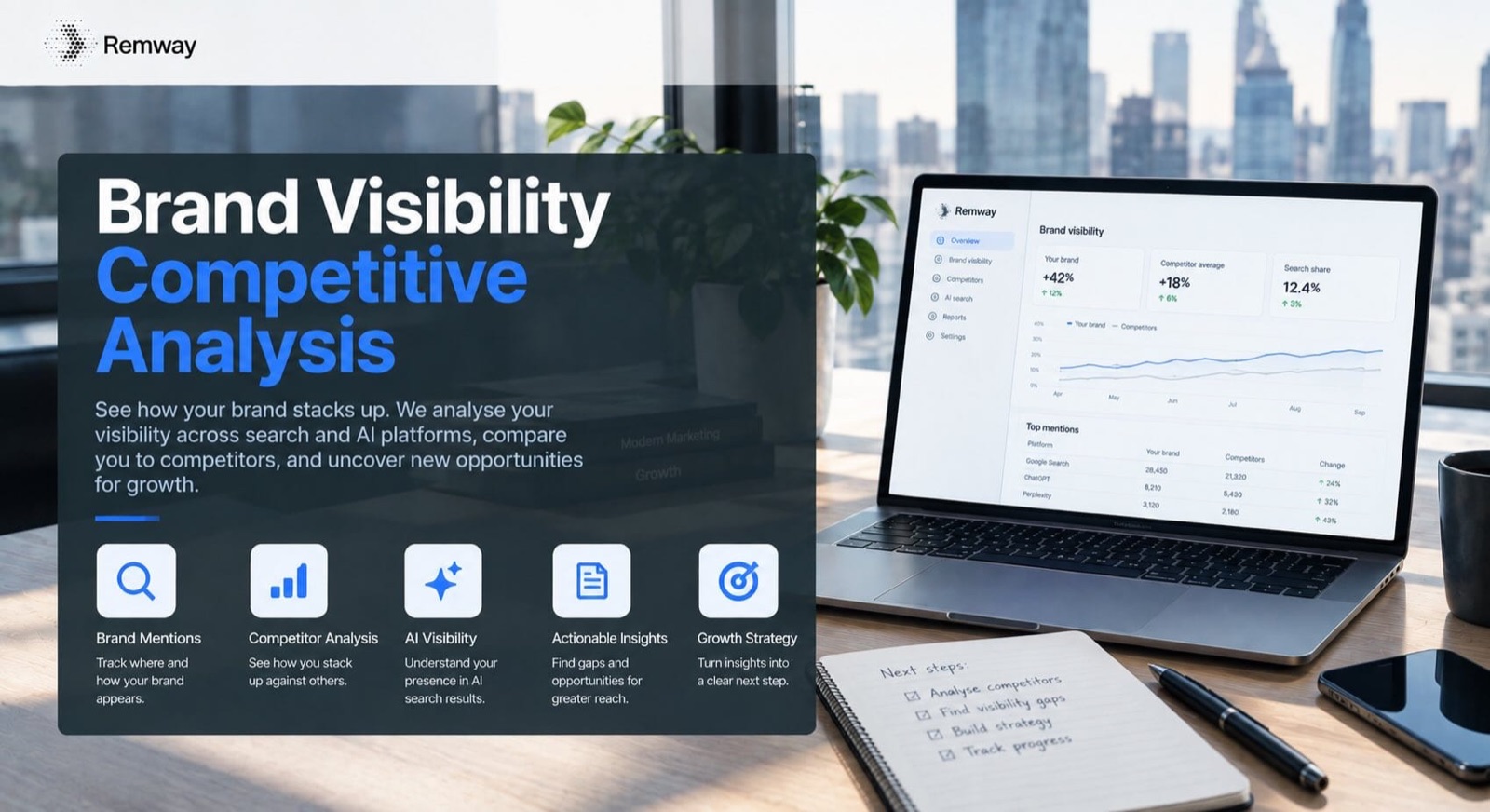
Practical steps for a small team include getting listed on relevant review platforms, pitching guest articles to publications your audience reads, and making sure your Google Business Profile is complete and accurate. A brand visibility competitive analysis can help you identify which external sources already cite your competitors but not you, which is often the fastest gap to close.
- Prioritise getting mentioned in comparison and roundup articles in your niche
- Keep review platform profiles (G2, Capterra, Trustpilot) accurate and up to date
- Pitch short, credentialed guest articles to publications your audience reads
- Complete your Google Business Profile and keep NAP (name, address, phone) consistent
How to measure AI search visibility for small teams without enterprise tools
Measuring AI search visibility for small teams is possible without expensive software, using a combination of manual prompt testing, GA4 referral tracking, and Search Console's generative AI report.
The key insight from ALM Corp's 2026 AI visibility tracking guide, citing SparkToro research, is that the same query run 100 times produces nearly 100 unique brand lists in different orders. This means tracking individual prompt rankings is unreliable. Instead, track your visibility percentage across a consistent set of 20 to 30 prompts, noting how often your brand appears rather than where it ranks in any single response.
A free, repeatable manual routine for a two-person team
Set up a shared spreadsheet. Every two weeks, run the same set of 20 to 30 prompts in ChatGPT, Perplexity and Google AI Overviews. Record whether your brand is mentioned (yes or no), and save the response text. Calculate a visibility percentage for each engine. This takes around 90 minutes per cycle and requires no paid tools. Over three months, you will see real trends rather than noise.
For automated tracking on a small budget, ALM Corp notes that Otterly AI's Lite plan starts at $25 per month billed annually. By contrast, Profound's own comparison lists its starting price at $99 per month and describes it as aimed at enterprise organisations, noting it is a poor fit if you are just testing AI search. For a detailed comparison of affordable options, see the Remway guide to Profound alternatives for small teams.
Inside Google Search Console, the Generative AI performance report shows impressions and clicks driven by AI Overviews. In GA4, create a custom channel grouping or filter for referral traffic from chatgpt.com, perplexity.ai and gemini.google.com to track direct click-throughs. For a full walkthrough of what to track in Gemini specifically, the AI visibility metrics for Gemini article covers the exact report settings.
- Manual prompt testing: 20-30 prompts, tracked fortnightly in a spreadsheet
- Search Console: use the Generative AI report for AI Overview impressions
- GA4: filter referrals from chatgpt.com, perplexity.ai and gemini.google.com
- Affordable trackers: Otterly AI Lite from $25/month; avoid enterprise tools until you need scale
AI search visibility for small teams: what Google says to ignore
Google has published direct guidance on AI search optimisation, and part of that guidance is a list of tactics that do not work and that site owners should stop spending time on.
As reported by The Keyword, Google's official guide explicitly lists two tactics to ignore. The first is creating an llms.txt file. This file format has been discussed widely in SEO communities as a way to communicate with AI crawlers, but Google says it plays no role in AI Overviews or AI Mode. The second is over-indexing on structured data specifically for AI purposes. Schema markup has legitimate SEO uses, but treating it as an AI citation shortcut is not supported by how the system works.
Google's core message is that AI Overviews reward the same things traditional Search rewards: clear content, genuine authority, and good technical fundamentals. A small team that publishes consistent, well-structured, human-reviewed content on real search queries will outperform a team chasing AI-specific hacks every time. For teams earlier in their content journey, focusing on striking distance keywords is often the fastest way to build the kind of indexed, ranking content that feeds AI Overviews naturally.
- Do not create an llms.txt file for Google AI purposes
- Do not add schema markup specifically to trigger AI citations
- Do not follow vendor claims that have no support in Google's published guidance
- Do focus on indexed, well-structured, authoritative content on real queries
Comparison: AI answer engines at a glance
| Engine | Source selection method | Crawler to allow | Key lever for small teams | Free measurement method |
|---|---|---|---|---|
| ChatGPT | Training data first, web search on demand | GPTBot, OAI-SearchBot | Consistent authoritative publishing over time | Manual prompt set; GA4 chatgpt.com referrals |
| Perplexity | Real-time web crawl, always cited | PerplexityBot | Crawlable, well-structured pages with clear answers | Manual prompt set; GA4 perplexity.ai referrals |
| Google AI Overviews | Standard indexing and ranking | Google-Extended | Rank well in traditional Search on the same query | Search Console Generative AI report |
| Gemini | Training data blended with live Search | Google-Extended | Google Business Profile + indexed content | GA4 gemini.google.com referrals |
Frequently Asked Questions
Is ranking number one in Google enough to appear in AI Overviews?
Ranking highly in Google improves your chances, but it does not guarantee inclusion. Google says a page only needs to be indexed and eligible for a snippet to qualify. In practice, pages that rank in the top positions for a query are more likely to appear in AI Overviews because the same authority and relevance signals apply. Strong rankings are the best proxy, but they are not a hard rule.
Do I need an llms.txt file or special schema to get cited by ChatGPT or Perplexity?
No. Google's official guidance explicitly states that llms.txt plays no role in AI Overviews or AI Mode, and over-indexing on structured data for AI purposes is listed as a tactic to avoid. Perplexity cites pages based on its real-time crawl of indexed content. Clear, answer-first writing and allowing the right crawlers in robots.txt matter far more than any special file or markup.
Which AI bots should I allow in robots.txt?
Allow GPTBot and OAI-SearchBot for OpenAI, PerplexityBot for Perplexity, and Google-Extended for Google's AI systems and Gemini. If your site uses a CDN or web application firewall, check those settings separately, as generic bot-blocking rules can silently block these crawlers even when robots.txt is correctly configured.
How do I measure AI visibility for free or on a small budget?
Use a spreadsheet to run 20 to 30 consistent prompts in ChatGPT, Perplexity and Google AI Overviews every two weeks, recording whether your brand appears. In Google Search Console, use the Generative AI performance report for AI Overview data. In GA4, filter referral traffic from chatgpt.com, perplexity.ai and gemini.google.com. If you want automation, Otterly AI's Lite plan starts at $25 per month.
How long does it take to see changes in AI citations?
For Perplexity and Google AI Overviews, changes can appear within a few weeks of publishing and indexing new content, because both use real-time or near-real-time crawling. For ChatGPT, changes to training data take much longer, often months, because they depend on periodic model updates. Track your prompt set consistently over at least three months before drawing firm conclusions about what is working.